Monday, August 20, 2012

Coachella Garden Brings Community Together

It's harvest time and community gardens are providing a bounty for people of diverse ages, backgrounds and geographies, so this week we're focusing our blog on a few great stories from these local growing efforts. This story was originally published as an article on the Coachella Unincorporated website. Coachella Unincorporated is a youth media startup in the East Coachella Valley, funded by the Building Healthy Communities Initiative of The California Endowment and operated by New America Media in San Francisco. 

By Johnny Flores
Youth reporter
Coachella Unincorporated

When Hilda Hinojosa’s baby has colic, all she has to do is walk across the parking lot and pick some manzanilla from among the various vegetables, fruits and herbs at Las Casas Apartments Community Garden.

She uses the herb, also known as chamomile, to soothe four-month-old Berenice to sleep.
“I don’t drive, so it’s much easier to come to the garden,” said Hinojosa in Spanish. “It would take me longer to get to the store, and my little girl would still be crying.”
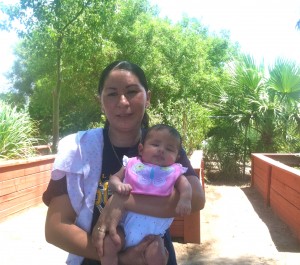
The residents of Las Casas Apartments work together in their community
garden, sharing their bounty with one another and their neighbors. Hilda
Hinojosa (above) grows and shares the manzanilla that she uses to make
tea for her daughter, Berenice. Photo credit: Coachella Unincorporated
Hinojosa has been planting in the community garden ever since moving to Las Casas eight years ago. During that time, she has developed a bond with her fellow community gardeners. The 20 or so active participants tend to their individual crops and share their bounty with one another. Because many are migrant farmworkers, the community gardeners look after each other’s crops when some leave the area to follow the seasonal harvesting work. One active gardener, Jesus Sandoval, even devised an irrigation system that makes the gardening easier for everyone.

Residents who don’t participate in the community gardens are still welcome to pick from them.
“I share my cilantro with everyone,” said Hinojosa, who plants hierba buena (spearmint), onions, nopales, (cactus) and cilantro. She makes salsa from the peppers and tomatoes grown by her neighbors.

Beatriz Gonzalez, who has also been an active community gardener at Las Casas for eight years, shares her corn, radishes, and strawberries. “We share what we plant with whoever needs it,” said Gonzalez, who works in the community garden after a full day of picking grapes in the fields of the Eastern Coachella Valley. “We let them in and give them what they need.”

Residents at Las Casas discuss their garden
Las Casas is comprised of three smaller complexes totaling 180 units of farmworker and family housing. This multi-family project was developed and is owned by NeighborWorks affiliate Coachella Valley Housing Coalition (CVHC), an award-winning non-profit organization dedicated to building low-income housing throughout the region. The organization provides a variety of comprehensive community service programs, such as childcare programs and computer classes, at each of its 31 multi-family complexes. Las Casas is one of five CVHC complexes with a community garden.

“These are farm workers who work to feed the country but don’t have access to food themselves,” said Josseth Mota, community services coordinator for CVHC. “We want to strengthen the community and allow the residents to work for pleasure and benefit outside of their normal job.”

Nadia Villagran, CVHC’s director of communications and operations, affirms that the gardeners are harvesting community along with their crops.
A close-up photo of the Las Casas bounty

“Through these gardens, we hope residents of Las Casas feel a true sense of community,” said Villagran. “In doing this, we want to be able to sustain the community and help those who cannot afford fresh produce to feed their families.”

To learn more about housing opportunities, or find out how you can help, visit www.cvhc.org or call (800) 689-4663.

Monday, August 13, 2012

NextGenCD: Who Am I?

In honor of the upcoming NeighborWorks America Young Professionals symposium, we have collected several blog posts from those under 35 asking their feelings on the meaning of community development. Share your comments on Twitter using #NextGenCD.
-------------------
By Sara Varela 
NeighborWorks America
Community Building and Organizing
communications specialist
I decided to title my blog entry “Who Am I” because that was the first question that popped into my mind when I read the prompt. Technically speaking I am over the 35 age limit we use to define ‘young’, but realistically speaking, “young” is a relative term. Plus, even if I am technically not that young any more, as the very famous Colombian song goes… “Yo tambien tuve 20 aƱos” ("I was also 20, once"). So I’d like to share some of my experiences and thoughts about community development.

In 1998 I was a young foreign student who had just arrived from Venezuela with hopes of finding a job, finishing my bachelor’s degree and understanding the American culture a bit better. I remember being in a bus in Manchester, NH and having a Spanish speaking person approach me and engage in conversation. This seemingly random person gave me a referral to a job opening at a great community development financial institution. After I got called for an interview, I reached out to this person again to give him an update. His one piece of advice was: “just make sure you say you like to work with the community”. I wasn’t really sure what he meant by that, but somehow, when the moment was right, during my first interview I said it – and that’s how I landed my first job in community economic development.


Flickr user naillkennedy Creative Commons
This concept of “community” has appealed to me ever since. I actually ended up doing a master's in community economic development, just to make sure I totally understood what this “community” concept was. However, I don’t really think I ever thought about what communities I belonged to, or I came from, or anything, until I started working in community development. I share this because a survey we did in preparation for the NeighborWorks Training Institute (NTI) symposium this Wednesday reflects that a great majority of young professionals currently working in community development stumbled across this line of work by accident, just like I did.

I have been working in this field ever since, and I love it. So, going back to my understanding of community development, I think it is the field that connects the haves with the have-nots, that teaches people to fish for themselves vs. giving them a fish. It is the connection between the corporate and the non-profit world. It attempts to level the playing ground for people living with lower income levels, less education and fewer assets. In my experience, community development is a very rewarding field of work and has been a fantastic discovery for me.

Trying not to lose the forest in the trees
However, in terms of career opportunities it can be challenging sometimes to see the bigger picture. I tend to get lost in the forest; I haven’t been able to see a clear path to career growth. When I worked at the local level, I learned that most organizations doing economic development have a very flat structure, which is great for many things, like: young professionals with a hunger for learning. This gives them the opportunity to take on responsibilities and projects of great importance; On the other hand, flat organizations have very limited growth potential, and young professionals tend to leave after a couple of years when it is apparent the only option for professional growth is to wait for someone in upper management to retire. I started writing this entry before seeing the results of the survey that went out to all the registered participants for the symposium, and I found it very interesting to see many of my feelings and observations reflected there.
Post-its from New Orleans NTI workshop

I will be participating on a panel in the symposium, and will take part in two courses the other days. I am really looking forward to the week ahead, and was very excited when I learned the symposium theme was young professionals, perhaps because I still feel I fit that category. So three cheers for those of us “young people” and the connections we will make, and three cheers for NeighborWorks America for choosing that theme as a focus. It will be interesting to see if more opportunities open up in the field – and within the organizations sending staff – because of the symposium theme and the conversations it will generate.


Friday, August 10, 2012

NextGenCD: Unlimited Potential

In honor of the upcoming NeighborWorks America Young Professionals symposium, we have collected several blog posts from those under 35 asking their feelings on the meaning of community development. Share your comments on Twitter using #NextGenCD.
-------------------

Isaiah Dawson,
NeighborWorks America
Community Scholar Intern
When I started my job, I thought that I was going to be a community scholar intern working directly on a summer social media research project. However, since the northeast regional staff is so small at NeighborWorks America, I ended up supporting the company and our network organizations in many different ways by using my prior knowledge of marketing and social media. I’ve since taken a greater interest in the development of social media strategy and training, and this has greatly affected my professional and personal growth. All this was made possible by the great people and culture at my nonprofit.

Nonprofits are becoming an ideal career destination for young people because new hires are exposed to various career paths, gain the skills they need quickly, and take on a great deal of responsibility early on in their careers.  By contrast, I've found private sector roles are much more formally and strictly defined, which means that it’s harder to try your hand at something new without changing jobs or acquiring years of experience. As a recent college grad, I am very appreciative for the opportunity to gain valuable new skills which will translate into opportunities down the road.

a word cloud of this blog entry created with Wordle,
an online word cloud generator
Right now, I feel virtually unlimited potential in developing my own unique career path.  I love that I’ve been able to have a great deal of responsibility at a young age and have become a consultant specializing in a particular area. My social media skills will be useful for years to come because nonprofit leaders increasingly realize the power of social marketing, and they value the expertise and insight of young professionals who understand the digital environment. Everything I'm doing now is setting me up for future success.


For me, though, the greatest advantage of working in community development is the easy access to everyone at all levels of the organization. I can share ideas and opinions with anyone, no matter their title. This openness is what makes nonprofits an ideal destination for young professionals interested in making a difference in the world. 

Thursday, August 9, 2012

NextGenCD: A Sense of Belonging


Jason Arnolod,
NeighborWorks Community Scholar,
Kansas City
In honor of the upcoming NeighborWorks America Young Professionals symposium, we have collected several blog posts from those under 35 asking their feelings on the meaning of community development. Share your comments on Twitter using #NextGenCD or follow Jason using @RepresentKC.
----------
A community is a place where people live, usually defined by a geographic region or another characteristic.  Community development  is a highly multifaceted field.  For some, it is a chance to own a home.  For others, it is an opportunity to build a career around helping people.  For underserved neighborhoods, it is often English as a second language classes, rental assistance, or after school student services.  A simple definition might be: “Community development gives people a chance to live their lives." 

In today’s world that is no easy thing. Globalization has reached into every corner of the planet, affecting our economies in a way that is still not understood. Shifting demographics have challenged our cultural and economic landscape, prompting us to learn new ways of doing things (see Sir Ken Robinson’s video on revolutionizing education).

A butterfly captures the mood on Lykins Neighborhood
Community Farm, Northeast Kansas City
My home state of Wyoming is built on the country’s largest coal reserves. That meant that I would enter either a low-wage service economy or the energy industry. So I did what many young people do. I left. I served with the Peace Corps in El Salvador for two years, and, when I returned, I saw my country with new eyes. There were opportunities literally everywhere. There were also enormous challenges.  While I had never been very motivated by climbing the career ladder (perhaps that’s why I was in the Peace Corps in the first place?), I found that I was now driven by a strong desire to do...something. This is not an unfamiliar story.  The question was, what? That is how I found myself living in Kansas City, studying entrepreneurship. I joined a young community of urban farmers with the goal of bringing local produce to market. 

My dream as a community development professional is to live and work in the same community. I want my children to belong.  I do not want to build a career as an outsider, delivering services to people who view me as an extension of some federal policy.  I want the life that I have been promising to people.  Do I still want to serve people?  Of course.  The difference is that I want to do it together.  And this time I am on familiar turf.  I speak the native language.  This is my home.  

In the last year of my service in El Salvador, I was befriended by several families.  They welcomed me into their homes and taught me about their way of life.  I was tremendously encouraged to have these relationships, since cultural isolation is very real.  I now hope to bring the same attitude to my work here in the states.  If you are an outsider, a foreigner in this community, I want you to know that you are welcome here.  That is how I was treated and I can offer no less.


My daughter, Annabelle, models for a
renovation project. Northeast Kansas City. 

Wednesday, August 8, 2012

Communities Find Success with Nontraditional Forms of Homeownership

This thought piece was originally published August 7, 2012 on the Bipartisan Policy Center's website. The questions were: Do alternative forms of homeownership, such as shared equity models and rent-to-own programs, present viable alternatives for future homeownership? Can they be taken to scale in a way that can encourage stabilization of neighborhoods and housing markets?

Photo of Eileen Fitzgerald
By Eileen Fitzgerald
Chief Executive Officer
NeighborWorks America
NeighborWorks believes that community stabilization requires a comprehensive approach to housing opportunities, which employs strategies that support traditional and nontraditional forms of homeownership, as well as rental options. This approach includes providing affordable inventory and low-cost accessible mortgage financing.

We certainly support alternative forms of homeownership, like shared equity and rent-to-own, as part of the strategy. Alternative homeownership models benefit people and communities. For generations, families with the resources to do so have lent money so their children can buy homes prior to inheriting wealth. This is an informal shared equity model which can overcome the inheritance gap. Formalized shared equity models or lease-to-own programs provide a way for people with less privileged social networks to achieve homeownership, and provide for long-term affordability, benefiting future generations. Done correctly these models not only provide an affordable homeownership option, they come along with education and support to make sure they are a sustainable arrangement for residents.

A number of NeighborWorks organizations have had success with shared equity and lease-to-own models. For instance, Durham Community Land Trustees and Champlain Housing Trust in Vermont have effectively used the land trust model to build homeownership opportunities for lower income families. Beyond Housing in St. Louis, Missouri has had success with its lease-to-own program.

There are new opportunities for scaling up nontraditional homeownership approaches that face challenges, but are worth exploring. Sometimes these strategies are resource intensive, so it is important to develop the organizational and external (legal, financing) infrastructure necessary for success. Local market conditions can also dictate what resources are needed to achieve success. For instance, one of the best places to use shared equity is a community with an inclusionary housing requirement, as is currently happening in an Austin, Texas program run by Habitat for Humanity. In those communities, little or no additional capital is needed to undertake the model.

In closing, we believe the best way to further community stabilization is through multiple strategies, which support many different forms of homeownership, as well as rental housing. All of those elements of a successful approach require flexible resources that can sustain plans tailored to the needs and resources available in each community.