Showing posts with label community development. Show all posts

Wednesday, May 8, 2013

NeighborWorks Rochester Expands Healthy Blocks Approach

By Ascala Sisk, Senior Manager
Neighborhood Stabilization
NeighborWorks America

Reposted from StableCommunities.org

NeighborWorks Rochester has partnered with residents in three neighborhoods to make exterior home improvements, address quality of life issues, and attract new residents and investment. Through this targeted “Healthy Blocks” approach, homeowners, tenants and landlords work together to create neighborhoods of value and choice.

After eight years of sponsoring “Makeover Madness” home beautification campaigns, organizing social events, planting gardens, sponsoring neighborhood clean-ups, and promoting new neighborhood branding, the Healthy Blocks approach has proven to be successful in improving physical conditions, creating pride, and fostering a community identity. For example, in “The Pocket,” a 7-block neighborhood of 750 residents in the East Main–Atlantic area, NeighborWorks Rochester has observed that physical conditions are improving, the average sales price is up 20 percent since 2008, and homes on the market sell in an average of 18 days as compared to 27 days in 2008 — all signs of a rebounding housing market.

Building on this success, NeighborWorks Rochester is considering candidates for its next two Healthy Blocks initiatives. To help with the selection and to train new staff members on the core components of this approach, NeighborWorks Rochester CEO Kim Brumber turned to David Boehlke, the nation’s leading Healthy Neighborhoods strategist. Joining them over the course of two rainy days in January 2013 were representatives from NeighborWorks Western Vermont who wanted to learn how they might apply this thinking to their own newly selected target neighborhood in the town of Rutland.

With a healthy dose of offbeat humor, Boehlke stressed the need for strategies that are grounded in market realities and build confidence among existing residents. “Markets need to be built,” he said, “not just houses.” This is especially true in cities with stagnant or declining populations where potential homebuyers have many homes and neighborhoods to choose from. In order to compete, you need to reposition your neighborhood in the marketplace. Building confidence in the future of the neighborhood validates people’s choice to live there, creates pride, and encourages investment because it makes economic sense.

So, how do you build confidence? A lot of it has to do with image and physical conditions. Neighborhoods with houses that are reasonably well-maintained and have tidy gardens and litter-free streets instantly convey that this is a neighborhood where current residents succeed, and where future homeowners would want to buy. But according to Boehlke, the key to building confidence is engaging residents and building their capacity to manage day-to-day neighborhood issues. Ultimately, people are more likely to invest in areas where residents work together to improve the quality of life.

Homes in Rochester
As NeighborWorks Rochester considers its next Healthy Blocks, it will select neighborhoods where resident engagement activities and modest investments in home repairs are likely to leverage additional investment. As the team from NeighborWorks Western Vermont also learned, Healthy Blocks’s focus on building markets, improving image and physical conditions, and fostering resident leadership offers lessons for other organizations that are designing place-based revitalization strategies.

To learn more about the Healthy Neighborhoods approach that David Boehlke created and teaches, take a look at his monograph, Great Neighborhoods, Great Cities, written about the Healthy Neighborhoods approach in Baltimore for the Goldseker Foundation.
 

Wednesday, December 19, 2012

Umpqua Local Goods: A Unique Approach to Community Development

This post comes to us from affiliate NeighborWorks Umpqua in Oregon. Leave a comment if your organization is promoting local shopping this holiday season!

By Anna Jen
Microenterprise Development
AmeriCorps VISTA at 
NeighborWorks Umpqua
Umpqua Local Goods in Roseburg, Oregon, is a groundbreaking new project aimed at revitalizing community and small business simultaneously. The project, made possible by a partnership between Phoenix Charter School and NeighborWorks Umpqua, takes a multifaceted approach to community development through its retail learning environment, retail space for vendors and commercial kitchen.

A century ago, Roseburg, Oregon, was a bustling country town in the heart of the beautiful Umpqua Valley. For visitors, the Grand Hotel was the place to stay. The 116 rooms featured hot and cold water, steam heat, and phones, all cutting edge in those days. This building was a focal point of Roseburg’s post World War II economy. Over the years, the hotel went through many renovations to accommodate its changing tenants, including a speak-easy card room in the basement during prohibition. After a fire, however, the building remained unoccupied for decades, until NeighborWorks Umpqua purchased it and began a mass renovation in 2002. Today, the building provides 37 apartment units for low-to-moderate-income individuals and families and four commercial spaces for small businesses.

In September 2012, Umpqua Local Goods opened its doors on the bottom floor of the Grand Hotel. With more space (it was previously housed just down the street), the store has been able to accommodate dozens more vendors. Stop by and you’ll find all sorts of unique items made by talented local artisans – from beautiful earrings and stone pendants to scented soaps made with Oregon rainwater, fresh produce, hand-carved wooden cars and airplanes, mouthwatering toffee and much more.

Students from Phoenix Charter School’s Retail Learning Program spend a few afternoons a week at the store to learn valuable job skills such as resume building, interview preparation, working with vendors, and pricing products. “The program creates lots of potential for students,” says Karry Johnson, store manager. “It helps them develop goals, open their minds, and think for themselves.” The program is not just for Phoenix students, but is open to the public; anyone who is looking to gain new skills and experience.

Attached to the store is a licensed commercial kitchen. Stocked with basic restaurant equipment, it provides the perfect work space for food professionals and entrepreneurs. Dana, a Douglas County resident, currently rents the kitchen four days a week and whips up delicious goodies, such as pies, cookies, granola, and brownies, which she sells in the store.

Even in the early stages of operation, Umpqua Local Goods is becoming well-known in the community. It’s initiatives like this that are investing in the local economy, building strong small businesses, and creating future leaders. For more information, please visit www.umpqualocalgoods.com or drop by 733 Cass Street to shop local!

Friday, December 14, 2012

NeighborWorks America Announces that the National Foreclosure Mitigation Counseling Program Has Served 1.5 Million Homeowners

1.5 million homeowners have received foreclosure prevention counseling by local nonprofits, national intermediaries and state housing finance agencies participating in the National Foreclosure Mitigation Counseling (NFMC) program administered by NeighborWorks America, one of the nation’s largest community development corporations. The latest report on the NFMC program also found the program has helped save local governments, lenders, and homeowners approximately $920 million.

Watch this inspirational video about the compassionate NFMC-backed foreclosure counselors who are making a difference in the lives of individuals and families.


Also notable in the report, NFMC clients who received a mortgage modification lowered their monthly mortgage payment, on average, $176 more per month than non-NFMC clients which represents $372 million in annual savings to NFMC-counseled homeowners. With more fixed-rate mortgages and lower interest rates, mortgage terms are becoming more favorable for homeowners. The percentage of clients that reported having fixed-rate mortgages with interest rates at or below 8 percent increased from 30 percent in October 2008 to 57 percent in August 2012. Nearly 69 percent of NFMC program clients report holding fixed-rate mortgages.

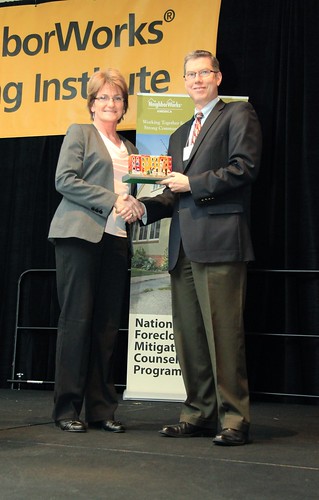
Jane Sokolowski Receives
Counselor of the Year Award
from Chuck
Wehrwein,
NeighborWorks America COO
On December 13 NeighborWorks America and the NFMC program sponsored the inaugural NeighborWorks National Foreclosure Mitigation Counseling (NFMC) Program Counselor Awards, which recognize the contributions of counselors whose tireless efforts help homeowners maintain homeownership and transition to suitable housing. The winners are the following: Jane Sokolowski - Catholic Charities (NY) for the Counselor of the Year Award; Betsy Carvajal - CredAbility (GA) for the Excellence in Counseling Award; Ali Tarzi - Community HousingWorks (CA) for the Excellence in Outreach & Professional Development Award; Amanda Diaz and Diego Tapia – Hispanic Association of Contractors and Enterprises (HACE) (PA) for the Excellence in Personal Achievement Award; and Rose Marie Roberts – Utica Neighborhood Housing Services NeighborWorks HomeOwnership Center (NY) for the Counselor Perseverance Award. More information about the award winners is available here.

To view photos from the event, visit our Flickr page.

Friday, November 30, 2012

What Does Quality of Life Mean to a Neighborhood?

This entry is reposted, with permission, from our Kansas City affiliate Community Housing of Wyandotte County's blog:  http://chwckck.org/blogs/blog.

Youth volunteers participating in our Community
Alley Restoration (C.A.R) program.
It can mean everything or it can mean nothing depending on who has defined what it means for your neighborhood. If you ask your neighbors what they want they will undoubtedly produce a list of things – like better sidewalks and curbs, faster police and fire response, less vandalism and fewer stray dogs and feral cats. Others want coffee shops, retail stores, bike trails, community gardens, or entertainment and recreational centers, even wireless Internet. It's true these things can make life in the neighborhood more enjoyable, more convenient and even healthier but what these things really do is create a sense of place.

A place where people can gather, can meet, share ideas and get to know one another. These environments are essential for our socialization. In urban neighborhoods many of the things that used to bring us together – like downtown shopping districts, neighborhood schools, mom and pop stores, park and recreational centers have been shut down, moved on or are under funded. Citizens have to deal with aging infrastructure, higher taxes and now bear the responsibility of maintaining alleyways, sidewalks and curbs or bringing their 100 year old homes into code compliance of new home standards.

Quality of life means a lot of things. It involves almost everything that influences a neighborhood from government regulations and ordinances, variety of housing stock, ratio of rental property to home ownership, household incomes, type of schools, cultural diversity, park services, youth programs, leadership and resident accountability. If you don’t have the recipe – that can be a tough cake to bake.

Freshly painted bike lanes in Wichita, Kansas
New plants being installed during Arbor Day
at Waterway Park in Kansas City, Kansas

Unfortunately, there isn’t a recipe that fits every neighborhood or maybe any neighborhood. You can have meetings and sounding sessions that may help exposure the most pressing issues, concerns or trends but any long term solutions come from neighbors getting to know one another. Developing lines of communication and trust with government, civic organizations and surrounding neighborhoods. It comes from creating a common sense of purpose about why we live here and why it is important that we learn to work together toward common goals. Its about believing in who we are and that what we do matters. 

Creating those gathering places is the first step in moving those types of conversations from small groups on our front porches to engaging the greater community. Sharing our ideas and cultures. Developing trust and friendships. Working on projects together, engaging our youth and our government and finding ways we can work together to make our communities better.

Wednesday, November 7, 2012

Training to Change the World


By Sara Varela, Community Building and Organizing program

October 25 to the 28 marked not only NeighborWorks Community Leadership Institute (CLI) in Orlando, Florida, but also my nine year old’s birthday, Hurricane Sandy passing through the East Coast, the closing on my house and much more. So needless to say, things have been crazy recently. However, it's worth stopping to reflect on the great things that came out of the CLI and why it matters.

The CLI is an annual gathering of 110 different resident volunteer teams from across the country. NeighborWorks America holds the event because we believe that residents are in the best position to make substantial positive impact in their communities, and that their impact will be even greater if these leaders are trained in best practices and can learn from the experiences of others.

Attendees are part of teams, each comprised of six to eight people who live nearby and come together to address a specific problem. During the CLI, team members participate in top-notch trainings with some of the best instructors in the country. Teams who submit an Action Plan to NeighborWorks America receive a $2,000 seed grant to help them leverage local resources and see their plans turn into reality.

These plans lead to great community projects, like the Sabor del Northside community festival in Houston, Texas, where schools, businesses, artists, community organizations, and residents came together to put on an event attended by more than 1000 people. Other CLI-related projects have included a cross-state safe prescription drug disposal program, a safety awareness fair, community gardens and youth leadership programs.

The CLI supports these community enhancement projects by providing a contagious, positive and invigorating experience for attendees that helps them to go from concept to completion. The CLI instructors are not what you might expect from a big corporate training event. Each of them was passionate about their work, so much so that their energy radiated from every classroom. They have taught me important skills, but most importantly, they have inspired me as have many of the participants who strive for greatness, to overcome obstacles and to expect positive change when communities join forces to solve their problems.

Dorothy Richardson mural from the Orlando
Neighborhood Improvement Corporation
The CLI is also the time where we honor the Dorothy Richardson Resident Leadership recipients, people who exemplify a spirit of service and a commitment to a better future in their communities. For profiles of these amazing people, check out nw.org/drawards. There’s also a great video there with stories about what a difference resident leaders can make.

Adding to these indoor activities, the CLI had practical workshops and tours of the Orlando communities. We also had a virtual presence via Twitter (see Storify summary) and a Facebook group for participants. Using these tools, attendees could comment on their experiences, talk with others and tocapture the event from their perspective.

It is the first time I’ve see so much interaction and engagement online from so many people. The Facebook group allowed many of us to meet in person, to learn what was happening in the sessions and tours, and hopefully it will continue to capture the energy and enthusiasm of participants as they implement their action plans over the next year.
Tap Bui (center) with her team from Mary Queen of Vietnam
from New Orleans. She was my partner in one of our sessions
and it's great to keep in touch using the Facebook group.

I am really hoping we can continue to see updates, photos and videos from every single team who attended the CLI. It would be fantastic if we could keep up with the successes, road blocks and challenges of the teams as they go back to their communities.

Overall it was a tremendously successful event that reminds me why I do what I do, and which I believe can change the world, one community project at a time.


Tuesday, October 30, 2012

5000 Starbucks Volunteers Help Fifth Ward CRC Make a Better Houston

By Gary Wolfe
District Director, Rocky Mountain Region


How do neighborhoods go from declining to improving? Fifth Ward Community Redevelopment Corporation (Fifth Ward CRC) has used partnerships to help turn around Houston’s Fifth Ward.  Most recently, Fifth Ward CRC partnered with Starbucks, during their Global Leadership Conference in Houston, to make a positive difference in the lives of the Fifth Ward residents.
Starbucks "Team Blue" built a playground

In early October, more than 5,000 Starbucks employees volunteered with community members to make a tangible impact.  Starbucks CEO Howard Schultz said to KHOU 11 News “When I walked through the Fifth Ward and saw the conditions of the houses and really the people in need, I just thought this is where we need to be.”

In the Fifth Ward, the day began when the thousands of Starbucks volunteers took a bus from their downtown hotels to staging grounds at local churches. There, they ate lunch, learned about the Fifth Ward neighborhood and grabbed the tools they needed to paint homes, install pocket parks and community gardens, clean up vacant lots, put up community artwork and the like. Fifth Ward CRC projects focused on the Lyon’s Avenue Corridor, a 22 block area which encompasses the community’s “main street” and comprised of residential, commercial and public spaces with a unique blend of historical markers reflective of the community’s native sons and daughters. 

In total, more than 9,000 Starbucks employees who attended the Global Leadership Conference participated in volunteer projects across Houston. On average, the Starbucks employees volunteered between four and six hours at each project for an impressive total of more than 42,000 hours of community service over the three days of the conference.
Lyons Avenue Renaissance sign with numerous partners listed
Lyons Avenue Renaissance sign with
numerous partners listed

For the Lyon’s Avenue Corridor area, the volunteering was just one piece of the ongoing revitalization work. Fifth Ward CRC is committed to a complete community renaissance, which will include not only great homes and clean streets, but also new jobs and opportunities. Michael Emerson, Chairman of the Fifth Ward CDC told KHOU 11, “This is an image for us of what Fifth Ward is going to be,” said “We’re creating an economically diverse, ethnically diverse, economically strong, new neighborhood here in Houston.” Fifth Ward CRC has formed partnerships not only with Starbucks, but also with the City of Houston, Rice University, University of Houston and the American Regional Institute of Architects to change the landscape and future of Fifth Ward. With the help of collaborations like these, Fifth Ward CRC can return to being a “neighborhood of choice.” 

To learn more about the Starbucks-Fifth Ward partnership, view this news video or click here to see more photos.

Friday, August 10, 2012

NextGenCD: Unlimited Potential

In honor of the upcoming NeighborWorks America Young Professionals symposium, we have collected several blog posts from those under 35 asking their feelings on the meaning of community development. Share your comments on Twitter using #NextGenCD.
-------------------

Isaiah Dawson,
NeighborWorks America
Community Scholar Intern
When I started my job, I thought that I was going to be a community scholar intern working directly on a summer social media research project. However, since the northeast regional staff is so small at NeighborWorks America, I ended up supporting the company and our network organizations in many different ways by using my prior knowledge of marketing and social media. I’ve since taken a greater interest in the development of social media strategy and training, and this has greatly affected my professional and personal growth. All this was made possible by the great people and culture at my nonprofit.

Nonprofits are becoming an ideal career destination for young people because new hires are exposed to various career paths, gain the skills they need quickly, and take on a great deal of responsibility early on in their careers.  By contrast, I've found private sector roles are much more formally and strictly defined, which means that it’s harder to try your hand at something new without changing jobs or acquiring years of experience. As a recent college grad, I am very appreciative for the opportunity to gain valuable new skills which will translate into opportunities down the road.

a word cloud of this blog entry created with Wordle,
an online word cloud generator
Right now, I feel virtually unlimited potential in developing my own unique career path.  I love that I’ve been able to have a great deal of responsibility at a young age and have become a consultant specializing in a particular area. My social media skills will be useful for years to come because nonprofit leaders increasingly realize the power of social marketing, and they value the expertise and insight of young professionals who understand the digital environment. Everything I'm doing now is setting me up for future success.


For me, though, the greatest advantage of working in community development is the easy access to everyone at all levels of the organization. I can share ideas and opinions with anyone, no matter their title. This openness is what makes nonprofits an ideal destination for young professionals interested in making a difference in the world. 

Thursday, August 9, 2012

NextGenCD: A Sense of Belonging


Jason Arnolod,
NeighborWorks Community Scholar,
Kansas City
In honor of the upcoming NeighborWorks America Young Professionals symposium, we have collected several blog posts from those under 35 asking their feelings on the meaning of community development. Share your comments on Twitter using #NextGenCD or follow Jason using @RepresentKC.
----------
A community is a place where people live, usually defined by a geographic region or another characteristic.  Community development  is a highly multifaceted field.  For some, it is a chance to own a home.  For others, it is an opportunity to build a career around helping people.  For underserved neighborhoods, it is often English as a second language classes, rental assistance, or after school student services.  A simple definition might be: “Community development gives people a chance to live their lives." 

In today’s world that is no easy thing. Globalization has reached into every corner of the planet, affecting our economies in a way that is still not understood. Shifting demographics have challenged our cultural and economic landscape, prompting us to learn new ways of doing things (see Sir Ken Robinson’s video on revolutionizing education).

A butterfly captures the mood on Lykins Neighborhood
Community Farm, Northeast Kansas City
My home state of Wyoming is built on the country’s largest coal reserves. That meant that I would enter either a low-wage service economy or the energy industry. So I did what many young people do. I left. I served with the Peace Corps in El Salvador for two years, and, when I returned, I saw my country with new eyes. There were opportunities literally everywhere. There were also enormous challenges.  While I had never been very motivated by climbing the career ladder (perhaps that’s why I was in the Peace Corps in the first place?), I found that I was now driven by a strong desire to do...something. This is not an unfamiliar story.  The question was, what? That is how I found myself living in Kansas City, studying entrepreneurship. I joined a young community of urban farmers with the goal of bringing local produce to market. 

My dream as a community development professional is to live and work in the same community. I want my children to belong.  I do not want to build a career as an outsider, delivering services to people who view me as an extension of some federal policy.  I want the life that I have been promising to people.  Do I still want to serve people?  Of course.  The difference is that I want to do it together.  And this time I am on familiar turf.  I speak the native language.  This is my home.  

In the last year of my service in El Salvador, I was befriended by several families.  They welcomed me into their homes and taught me about their way of life.  I was tremendously encouraged to have these relationships, since cultural isolation is very real.  I now hope to bring the same attitude to my work here in the states.  If you are an outsider, a foreigner in this community, I want you to know that you are welcome here.  That is how I was treated and I can offer no less.


My daughter, Annabelle, models for a
renovation project. Northeast Kansas City. 

Tuesday, August 7, 2012

NextGenCD: Imagery as Identity

 In honor of the upcoming NeighborWorks America Young Professionals symposium, we have collected several blog posts from those under 35 asking their feelings on the meaning of community development. Share your comments on Twitter using #NextGenCD.
----------------------

Reneé Bibby,
marketing coordinator,
Primavera Foundation
About six years ago I had a strange experience: I was watching a reality TV show, when I discovered that one of the contestants, a young woman of mixed heritage, resembled me. My ethnic heritage is an uncommon mix, and my racial ambiguity has forced me to engage in dialogues surrounding race on a rather regular basis. But, while I’d studied issues of race in college, my emotional connection to the issue had been rather micro; I thought mainly of race in relation to my day-to-day interactions with other people. Discovering a person on TV who had skin color like me, who had the same texture of hair as me, created powerful exhilaration and pride. Seeing myself reflected—even for the briefest moment—in the media prompted a personal and professional revolution, which directly affects my work with Primavera Foundation’s community development services.

As the marketing coordinator, I complete all the photography and design work for our organization, which means I also work with the communities that partner with Primavera Foundation to build healthy, thriving neighborhoods. I am in a unique position to serve as conduit for the families, the individuals, and the community as a whole to become bright beacons in a dark media landscape.I make it my personal mission to meet with our participants, to hear their stories, photograph them, and provide a forum to share that with a wider audience.
First time Hispanic single female homebuyer helped by Primavera
photo courtesy of Primavera Foundation
Tohono O'odham homeowner in south Tuscon
photo courtesy of Primavera Foundation
It means something for people to see their imprint in the world. I’ve experienced that personally, so I understand what it means when we create those opportunities into our community development work.  I choose to use photographs, stories, design, and language that reflect who they are, and who they want to be—allowing the communities to have creative ways of saying, “We are here. We exist.” So that, hopefully, in the years to come, a young woman of color can look at into the wider world and say, “I see myself here.” And that won’t be a rare moment for her.

Friday, August 3, 2012

NextGenCD: Evolving Definitions


In honor of the upcoming NeighborWorks America Young Professionals symposium, we have collected several blog posts from those under 35 asking their feelings on the meaning of community development. Share your comments on Twitter using #NextGenCD.
-------------------

Dani Rosen, NeighborWorks America
community scholar intern
NFMC Quality Control and Compliance
At each stage of my academic and professional life, “community development" has emerged as a different issue, program, or agenda. My interest in community development started at the local level – while I was working as an AmeriCorps VISTA member in Hudson County, New Jersey. While there, I saw community development as an effort to increase access to resources for families and individuals in need. This definition broadened while I studied as a Master of Urban Planning student at New York University (NYU). In the classroom, I learned about community development as neighborhood organizing. For example, the way Jane Jacobs fought to preserve the local character of homes and shops in Greenwich Village, New York.

Unfortunately though, I also came to understand that in many areas the phrase "community development" is used as a disguise for potentially unwanted change in a community in transition. Developers and city officials use the term to smooth over the introduction of out-of-context buildings or large commercial developments that could alter the nature of a specific neighborhood.

I currently understand community development as an investment in a specific area. The investment can be financial, political, or social and the area specified can be a block, a neighborhood, or a metro-area. With the right motives and support community development can make a substantial impact.  The strength of community development can best be seen in the depth and breadth of projects and programs available.

Image courtesy of Creative Commons
Community gardens are a great example of what community development can achieve at the local level. Community gardens have become incredibly popular in urban areas in the past few years. They come in all shapes and sizes and bring many different advantages to an area. Community gardens are social and financial investments that provide both education and opportunity for social interactions. They provide fresh produce, often to those who lack other access to fruits and vegetables. They also reinforce the connection to local land as residents work to transform patches of dirt into small, but beautiful natural spaces.

At the state level, community development has the potential to benefit a much larger audience. NJ After 3 is an initiative to provide quality after school programming for school-aged children in New Jersey.  The program goals include reducing gang involvement and increasing scholastic enrichment so that all members of the community have the opportunity for a better future. NJ After 3, and similar programs, fill a gap by giving working parents more structured time for their children when parents cannot be at home.

There are countless additional examples of community development addressing other issues at multiple levels of focus.  The value of each program rests in the benefits that are brought to the individuals and families involved.  Community development has the potential to be a “catch all” phrase but I think that is one of the most important strengths of the field. Because community development includes many different types of investments in a range of geographic sizes, successes are magnified and can be celebrated by the entire field.

Wednesday, August 1, 2012

Community Leadership Institute Success: the Sabor Del Northside Community Festival

By Sara Varela 
NeighborWorks America
Community Building and Organizing
communications specialist
This entry is reposted from the Leaders for Community blog: http://ow.ly/cFdyb

The NeighborWorks America Community Leadership Institute (CLI) is coming up in October, an event where local leaders from throughout the country gather together to learn how to better serve their communities. I have been generating excitement online using a Facebook group and this week I decided to read through the outcomes tagged as CLI projects to share success stories with the group. CLI outcomes are one of my favorite topics to read about, because the ideas for the projects are generated by a team of resident volunteers who attend this national event, and then go home full of energy and make positive changes in their communities. It is resident empowerment at its best.  Avenue Community Development Corporation (Avenue CDC) in Houston, Texas submitted this text and photos. This story is great because it shows what can be accomplished when residents who care partner with organizations that are ready to support them.
-------------
“Schools, businesses, artists, community organizations, and residents came together at “Sabor Del Northside” to celebrate the great things in the Northside. What began as a brainstorm from eight resident leaders became reality as more than 1,000 people flocked to Ketelsen Elementary for this vibrant community festival.
Image courtesy of Avenue CDC and Epic Shots Photography

Even before the festival day, the “Sabor Del Northside” planning committee considered the event a success, because the planning process truly brought the community together. More than 50 organizations and businesses signed up to have booths at the festival to showcase their work. Project GRAD hosted a student art show on the next block. Local bands signed up to play, and cheerleaders and dance groups eagerly asked to perform. Parent-teacher organizations sold tacos and drinks to support their schools. Lindale Civic Club brought out children’s games and prizes. Marshall Middle School created elaborate decorations. It seemed that the idea of a festival, located in the heart of the neighborhood, sparked the collective imagination of the community.

Image courtesy of Avenue CDC and Epic Shots Photography

At the festival, it was clear that there is so much to celebrate in the Northside. The festival was also the groundbreaking for the new Ketelsen SPARK Park, a beautiful new community playground and park that will be built this summer.

The festival was funded by a $2,000 NeighborWorks America CLI grant, and including volunteer hours and in-kind donations, leveraged more than $43,000 in resources.”
-------------
For additional photos from the Northside neighborhood and the great work they are doing visit their Facebook Page. To stay in touch with Sara Varela, you can use @SaraVarelaCBO on Twitter.

Tuesday, July 31, 2012

NextGenCD: Valuing Mentors

In honor of the upcoming NeighborWorks America Young Professionals symposium, we have collected several blog posts from those under 35 asking their feelings on the meaning of community development. This first post is a variation on that theme.  Share your comments on Twitter using #NextGenCD.
----------
Kate Titford, NeighborWorks
America, General Counsel


When I was first asked to blog on “What Community Development Means to Me,” I spaced out for a few minutes — not unlike the kid in A Christmas Story after he is assigned the theme “What I Want for Christmas.”  And as I reflected on a career that has held at least as much excitement and joy as a Red Rider BB Gun, it was the faces that stuck out to me more than the accomplishments.  So I am exerting some editorial liberty and assigning myself the more relevant theme:  “What my Community Development Mentors Have Meant to Me.”

Marcea, my boss at that first job, broke me into office life and introduced me to the different moving parts of the community development scene.  When the going got tough at the national housing intermediary where we worked, Marcea encouraged me step up to the plate on challenging new projects that stretched me professionally and cultivated my passion for this work.  I laugh to think about my early days in the 9-to-5 world:  I was a spirited 22-year old who wouldn’t be caught dead in a suit. 

Marcea and Me
Some years later, when I was mired in a law school funk, another mentor — Brenda— scooped me up and helped me stay connected to local housing issues.  Her own career and activism were a constant reminder that my exile in law school would ultimately contribute to my work in community development.

I owe much of my happiness in my professional life to these mentors.  Their generosity of time and knowledge helped guide me through the critical junctures to where I am – who I am – now in community development.  They made an investment that will pay off for the entire field of community development.  As we descend on Cincinnati to discuss the opportunity of welcoming the next generation of leadership to community development, let’s pause and remember what mentors have meant to each of us in our careers.  Let’s pay tribute to those who helped each of us find our own special place in the field.  And —above all— let us recommit ourselves to mentoring the young professionals who will usher community development into its next era.

Monday, July 30, 2012

Working Together for Maximum Impact: NeighborWorks Rural Initiative


David Dangler,
NeighborWorks America,
director of Rural Initiatives

 The NeighborWorks Rural Initiative in 2012 is a far cry from the dozen or so rural groups who came together in the early days of the NeighborWorks network. Now there are 91 organizations participating in the Rural Initiative – and they include many of the network’s most productive members. In 2011, Rural Initiative members made direct investments into their combined communities of over $1.574 billion in 45 different states. When we drill down into the statistics, we find the Rural Initiative members are consistently in the top 25 producers in the NeighborWorks America network. This is supported by the data below, taken from a recent report on the NeighborWorks America Network entitled "It Takes a Network." All data is for 2011.

These high production figures become even more impressive when measured against the relative size and population density of many of the communities being served. For example, Wyoming Housing Network (WHN) runs a statewide program which created more new homebuyers in 2011 than any other NeighborWorks chartered network member. That in itself is impressive, but the story is larger than that. For many of the rural communities WHN served, their new homebuyers represented a significant percent of the total market activity. To illustrate, let’s use a purely fictional town we’ll call Antelope Falls, Wyoming which represents real towns I’ve seen throughout our rural network. There may have been only 10 total first time homebuyers in Antelope Falls in 2011, and of that 6 people were buyers educated by WHN – meaning WHN’s work affected 60% of the total market. In many urban environments the total number of homebuyers educated might be larger, but the percentage impact on the market is often smaller.

Another key element of the Rural Initiative network’s success has been collaboration across markets and lines of business. For example, we’ve been working closely with CFED and the  Ford Foundation to create asset-building opportunities with factory built housing in rural and urban environments.  These efforts have supported two of the most innovative and impactful social enterprises in the community development field ROC USA and Next Step. ROC USA helps residents purchase their manufactured home parks from absentee owners, and Next Step helps to replace substandard manufactured homes with Energy Star rated factory built homes. To succeed, both ROC USA and Next Step rely upon the NeighborWorks network for key lines of business – community building and organizing, home ownership education and training, rental property development and management and affordable lending.
Members of the NeighborWorks Rural Initiative, Rural LISC
and RCAC at the June conference in Visalia, California
Another key program component, which our partners have come to rely upon, is the rigor of the NeighborWorks standards for evaluating lines of business and organizational health.  Our member organizations are assessed regularly and measured against their peers and industry standards.  In addition, NeighborWorks Rural Initiative members share best practices with one another at events like this year’s June rural conference in Visalia, California. At this event, we not only collaborated within our own network, but also with two other major rural networks – Rural LISC and the Rural Communities Assistance Corporation (RCAC).

Looking ahead, we’re excited about expanding our asset-building strategies to include rural rental housing and a range of green applications that will be good for both built and natural environments. I’ll be writing more about these efforts in future blogs so stay tuned. You can subscribe by entering your email in the right side of this page.

Wednesday, July 18, 2012

Giving New Meaning to Summer Break

Photo of author Alexandra Chaikin
By Alexandra Chaikin,
Online Media Project Manager
Summer break is in full swing and many local NeighborWorks organizations  are using the time off from school to get kids involved in their communities. Below are a few of the many great projects going on around the country:

Michigan
Ava and Maria in the vegetable garden
Youngsters from the Detroit Country Day School Junior Community Service Club are helping Lighthouse of Oakland County by tending a vegetable garden with zucchini, spinach, tomatoes, lettuce, carrots, and peppers. The fresh produce supports Lighthouse of Oakland County's emergency food pantry and provides important nourishment to seniors.


Pennsylvania
A nonprofit called Little Acts of Love (West Lawn, Pa.) paired up with Neighborhood Housing Services of Greater Berks (Reading, Pa.) to get Berks County youth to help the elderly by painting, roofing, and doing various other chores to lend a helping hand to the less fortunate.  Ten houses on Second, Front, Pear, and Buttonwood streets were improved by the efforts. This project was featured in the Reading Eagle news.

Virginia and Maryland
Research from Johns Hopkins the shows that two-thirds of the 9th grade academic achievement gap between disadvantaged youngsters and their more advantaged peers can be explained by what happens over the summer months during the elementary school years. To combat this, Arlington-based AHC Inc. is helping more than 120 children combine education and fun over the summer. This year's theme is the Olympic Games. Along with swimming each week, campers participate in a variety of educational activities and field trips to such places as local museums, Imagination Stage, and Upton Hills Water Park.

Texas
This summer, Alamo Area Mutual Housing is running a Dr. Seuss-themed reading program at one of its community Learning Centers. The program culminates in an end of summer bash, where kids will be able to celebrate their reading achievement - and the top 4 readers will participate in a field trip to Splashtown waterpark this month. In addition to the reading program, Alamo Area Mutual Housing is offering a 4-H math and science camp, gardening opportunities, and a chance to perform in plays and talent shows.

Wednesday, July 11, 2012

Building Grassroots Leadership in South Carolina

By Hillary Rowe Wiley,
NeighborWorks America
public affairs and communications
advisor, Southern District

NeighborWorks America began in 1968 as a result of resident leaders who took up a charge to improve their neighborhoods (history here), so it makes sense that resident empowerment is still a crucial component of what we do.  One of the best ways we have found to promote resident leadership is to strengthen ties between local groups so they can develop their own networks, share and build best practices, and ultimately work toward solutions for complex challenges.

Last weekend NeighborWorks America’s Southern District, in collaboration with South Carolina Associations of Community Development Corporations (SCACDC) sponsored a Grassroots Leadership Institute (GLI) in Greenville, South Carolina. In keeping with our goal of engaging a variety of public and private partners, our partner SCACDC attracted the support of the City of Greenville, Spartanburg Regional Healthcare System, TD Bank, GCRA and Homes of Hope.

The GLI attracted around 150 diverse grassroots leaders, ranging in age from young adults to retired citizens, all banding together to experience “Empowering Your Community from the Ground Up – with Real Solutions for Real People in Real Neighborhoods.”

Classes taught residents a variety of skills, including how to build safer communities, promote healthy living, develop political clout and strengthen personal leadership skills. Panelists included Southern District Director Donald Phoenix, South Carolina State Representative Chandra Dillard, and SCACDC President and CEO Bernie Mazyck. “Connecting with the community - being in conversations with emerging leaders to retired residents, sharing best practices and learning from folks at the grassroots level is the foundational work necessary to stabilizing and transforming communities,” said Phoenix.


Donald Phoenix with Rep. Chandra Dillard and Bernie Mazyck
During the event, I spoke of Dr. Norman Vincent Peale’s leadership principle: “looking for the gold” or positive in every situation. I chose this theme because I know community development can focus on everything that isn’t working – blight, drugs, poverty, all the things that can undermine a neighborhood’s stability and success. As a result, sometimes we forget to look at community assets. All too often we get into what is known as the failure habit – which is focusing on and complaining about everything and anything that’s not working. This can lead to feeling overwhelmed or burnt out, so it’s important to celebrate successes and focus on the positive.

I hope that as a result of the institute, many community leaders will return to their neighborhoods with new connections and new knowledge that can support their projects, and with expanded sense of possibility for what their communities could become. So far, what we heard at the conference supports this goal. One local pastor who had just returned to Greenville after a four-year stint in England, was initially unsure of the GLI saying he knew few people in Greenville and did not yet feel part of the community. However, by the conclusion of the institute he was fired up saying, “This was great! Now I’m connected to so many people, and I now know what to do to help create and change community on a level that’s very different from my traditional pastor role. Thanks so much. This was really great!”

I am proud what we’ve achieved already and I look forward to the stories and photos we’ll be gathering from all the local successes.


Wednesday, May 30, 2012

On the Road with Chuck: Part II

Chuck Wehrwein
NeighborWorks America COO
When I arrive in DC, I know I’ll be getting lots of questions about why I left the beautiful Rocky Mountains for the city life, so I want to explain my reasons here. The truth is that it was no easy decision. I’ve been living in Colorado for over 11 years and my children have grown up there, so I would not be headed east if I weren’t strongly motivated to join the NeighborWorks team.

In fact, my enthusiasm is already high enough for others to take notice. The day before I left Denver, my wife and I were meeting with LeeAnne, our realtor. When LeeAnne asked me to explain what NeighborWorks is about and why I was leaving, I spent several minutes describing the organization, its members and the great work that takes place in communities across the nation. LeeAnne was immediately struck by the passion in my voice, and commented that she, too, felt inspired by our vision of building strong, vibrant communities.
Pagedale Senior Housing was built across from
a Save-a-Lot grocery as part of the 24:1 initiative

I found a great example of this work in St. Louis last Friday. I met with Beyond Housing’s leader, Chris Krehmeyer. We talked a little bit about his experiences as a NeighborWorks organization and he showed me a small sample of the economic development projects and housing they’ve been building in the inner ring suburbs of St. Louis as part of a program called 24:1. This initiative has three main goals: strong communities, engaged families and successful children and it is addresses each goal by really integrating the various elements of community – from district schools to housing for the elderly to a new grocery store making fresh produce more available to residents.

Great work like this is inspiring and is indicative of why I am so pleased to be taking on my new role as COO. I’m looking forward to meeting with and hearing from more of our members in the coming weeks as we begin to formulate, together, how we can better develop responses to the myriad needs and opportunities in our communities across the country.

Friday, May 25, 2012

On the Road with Chuck: Part I

Chuck Wehrwein
NeighborWorks America COO
My name is Chuck Werhwein and I’m looking forward to being the next Chief Operating Officer for NeighborWorks America. In my new position, I will be overseeing activities in communities all over the US, so I’ve decided to make my journey to DC reflect that; I’m making a road trip from Denver, Colorado to Washington, D.C., and stopping to meet NeighborWorks staff and network members along the way.

Denver Convention Center’s
Blue Bear (Creative Commons)
Although I’ve been in the community development field for over 20 years (bio here), there is always more to learn. My goal is to make my first few months a time for listening. Right now, I’m most interested in answering one big question: “How can we accelerate community change in times of constrained resources?”

I jump-started my trip in Denver at the Rocky Mountain District office, followed by a visit many miles later with Midwest Regional Director John Santner and his team in Kansas City over delicious local BBQ.

Kansas City BBQ (Creative Commons)
In both places, I was struck by the breadth of our staff’s experience and their deep commitment to residents and members. Their diverse backgrounds and extensive knowledge are extremely valuable resources, critical to our corporation’s ability to deliver much-needed community services with limited staff and budgets. I left Kansas City with a real sense of optimism about our ability to work as partners while tackling the challenges that lie ahead.

My next stop is St. Louis, Missouri, where I’ll meet with Beyond Housing’s Executive Director Chris Krehemyer and gain the perspective of a network member. In the meantime, I’ll be reflecting on what I’ve learned and brainstorming ideas for the future.

Friday, May 11, 2012

Inspiration from New Orleans

Photo of author Alexandra Chaikin
By Alexandra Chaikin,
Online Media Project Manager
For the past four days I’ve been very lucky. I have been working in the vibrant, complex city of New Orleans at the NeighborWorks Training Institute, meeting many of the people who make positive social and economic change possible in communities across this country.

Every day I’ve heard new stories of success and transformation – turning superfund sites into urban gardens, empowering residents to build anew after Katrina, partnering with banks to stem foreclosures, the list could go on. What’s been most striking to me is the accumulated knowledge of the conference attendees and their willingness to share that knowledge, and receive knowledge from others, in service of the greater good.

I also saw with clarity the importance of NeighborWorks training division staff in making this exchange of ideas possible. I believe passionately in the value of online media (hence my title!), but it is the in-person conversations that often inspire new or improved courses of action. I applaud our staff for their work behind the scenes organizing the classes and meetings in a way that enabled these discussions.

For those of you who could not attend, or who want a quick reference for inspiration, here were some of my favorite quotes and photos:

Photo by Chad Klawetter via Instagram
“Our city is not in a rebuilding phase; it is in an opportunity phase.”
–Brian Lawlor, director of housing policy, City of New Orleans at resident leadership symposium

 “The Community Building and Organizing program has already surpassed its goal of developing 7000 resident leaders.”
–Eileen Fitzgerald, CEO of NeighborWorksAmerica at CB&O dinner

“The challenge is to constantly expand ordinary people's self confidence.”
–Marie Kennedy, keynote speaker at resident leadership symposium

The photo and quotes were submitted via Twitter. You can see more on our Storify page. You can also visit the Leaders for Communities site for materials and discussion related to the May 9 symposium on resident leadership. To learn about all of NeighborWorks' efforts in the Gulf, visit our website.