Showing posts with label life after foreclosure. Show all posts

Thursday, May 1, 2014

Eddie’s story: Foreclosure ends one chapter, starts another

By Pam Bailey, NeighborWorks America blogger

Below is the final story in our four-part series on “life after foreclosure.” Read the previous posts beginning here.

One of the lessons Eddie Hines has learned from his ordeal of the past four years is to seek professional help early.

Hines and his wife bought a house in Pittsburgh in 2000. It was their first, and he admits now that they did it “blindly” – without the expert counseling provided by organizations like NeighborWorks of Western Pennsylvania, which stepped in later to help, in much less happy circumstances.

Hines was in good company, unfortunately. A survey commissioned by NeighborWorks America last fall found that when asked where they would go first for advice before buying a house, more than a third of American adults (39 percent) cited family and friends who had already purchased a home. Distant runners-up were the Internet (17 percent) and real estate agents (16 percent). Far behind were housing counselors and (more specifically) non-profit homeownership advisers (3 and 5 percent, respectively).

“We bought directly from the owner, and he took advantage of our obliviousness,” recalls Hines. “We basically paid too much.”

Still, they lived in their home comfortably until Hines, a school counselor, lost his second job with the local newspaper when his shift was cut. The income on which the family of four had relied dropped significantly, and they didn’t make the necessary budget changes. “We had gotten attached to a certain lifestyle,” he admits now. “We didn’t face up to reality.”
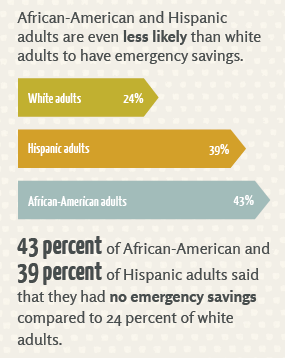
A NeighborWorks America
survey found a widespread
lack of emergency savings.
Once again, Hines was part of a national “epidemic.” A 2014 survey commissioned by NeighborWorks America found that almost a third of adults have no emergency savings, and another 21 percent have only enough to tide them over for a month. A related poll conducted by the National Foundation for Credit Counseling documented that just two in five U.S. adults (39%) – a proportion that has held roughly steady since 2007 – say they have a budget and keep close track of their spending.

The resulting stress proved too much for Hines’ marriage, and his wife moved out, leaving him solely responsible for the house. When he became ill, forcing him to take extended sick leave from his job at the school, it was the proverbial last straw. Hines tried to apply for a loan modification while he was still paying, but was denied because he was current – a common Catch 22. When Hines eventually fell behind on his mortgage payments, he was denied once again due to his wife’s refusal to co-sign.

Eddie Hines and Devon March
Finally, he turned to Devon March, a counselor at NeighborWorks of Western Pennsylvania.

“I was extremely stressed at that point,” he recalls. “I had lost my family, and living alone. Devon assessed the situation and asked me a simple, direct question, ‘Is this house worth the cost to you to keep it?’ And I realized the answer was no.”

Since then, Hines and March have become more than just client and counselor, frequently emailing each other to keep in touch. Today, Hines is renting an apartment and is back at work. He is still meeting with March, this time to build a budget and action plan so that he can someday become a homeowner again. With her help, he is on track to achieve that – just not right now.

“Eddie has a very positive attitude,” March says. “It’s like he has begun a second life. Now that he has a plan, he can sleep at night.”

Hines agrees: “Overall, I can say now that the ordeal has had some positive effects. If you take this kind of thing too much to heart, it will destroy you. But I’ve discovered my own resilience, and learned not to take everything so personally. I can’t control the actions of everyone else, so I am focusing on me.”

Although he is happy in his apartment for now, Hines still values homeownership because “it teaches my children, for whom I want to be a role model, to strive for your goals. They look to see how you handle adversity, and I want to show them that you can bounce back.”


Wednesday, April 30, 2014

Preserving ‘home’ after break-up and illness: Angela’s and Winnie’s stories

By Pam Bailey, NeighborWorks America blogger

Below are the stories of two women who sought help from a professional participating in NeighborWorks’ National Foreclosure Mitigation Counseling (NFMC) program – with two different outcomes, but the same fighting spirit. The five stories told in this series offer a flavor of both the trauma that foreclosure inflicts on families, and the ability of the human spirit – aided by the practical support of a trusted advisor – to bounce back. Read the previous posts here and here.

Angela Hawthorne, Illinois

“Happily ever after” is one of those fairy-tale phrases that in real life, only applies to about 50 percent of marriages.  That’s what Angela Hawthorne discovered, nine years after she and her husband moved into a house in Flossmoor, IL, with their two children.

Angela Hawthorne
Suddenly, Hawthorne found herself responsible for a mortgage on her own, on an income that had dropped precipitously when she took a leave of absence from her job as an underwriter for professional liability insurance to care for her ailing father. She attempted to negotiate with the lender directly and received a significant modification that gave her some breathing room -- but for three months only.

“I would find myself crying in the shower in the morning,” recalls Hawthorne. “But I couldn’t show it. At home, I had two kids to look out for, a daughter going on 15 and a 6-year-old son. I had to keep up a good front so their life was as normal as possible, and they could concentrate at school. I didn’t want them to worry about what was going on.”

In April 2012, a county mediation service referred Hawthorne to the South Side Community Federal Credit Union, where counselor Wilane Boone reviewed and improved her application for a loan modification. Unfortunately, Hawthorne failed to meet Federal Housing Administration guidelines for her debt-to-income ratio, and a summary judgment was issued authorizing foreclosure. Nevertheless, Hawthorne credits Boone for helping her navigate through the confusing and jarring process.

“Wilane was very insightful, and was always very straightforward and honest with me,” says Hawthorne. “She explained everything to me step by step and kept track of all of the paperwork so it wouldn’t get lost in the system. I never felt in the dark – which was huge for me.”

There is a happy ending to this story, however. Despite declaring personal bankruptcy in July 2013, she is now renting a new home, with hopes of purchasing it one day, just 15 minutes from the house she lost. Her children didn’t even have to change school districts.

“I learned that sometimes you have to just let go, and rely on your inner strength,” says Hawthorne, adding that for her, that strength came from a re-discovered faith in God. “Once I did, I felt a calm come over me.”

Winifred Octave, Massachusetts

Unemployment, or a significant reduction in pay, is the trigger for more than 60 percent of families who seek help from advisers who receive support from Neighborworks’ National Foreclosure Mitigation Counseling program. “Winnie” Octave, a single mother of three, brings that statistic to life.

Octave bought her rehabbed home in Worcester, MA, in 2001 from a local community development corporation. All was fine until she suffered a serious break in her arm and could not work at her job as an administrative assistant with the city’s bankruptcy court. Octave was replaced, and now unemployed, she struggled to pay her mortgage.

“I called my bank before I stopped paying, but they told me I had to fall behind before they would talk to me! It’s like a trap,” remembers Octave. “So I paid my overdue credit card bills instead. When I couldn’t pay the mortgage any longer, the bank gave me six months forbearance. But when the time was up, I still hadn’t been able to get a job.”

Winnie Octave (second from right) and (from left) her
daughter Danielle; son Rohan; nephew Juddah; and
son Tarik. 
In 2010, when she had fallen behind on her mortgage for nearly two years, Octave attended a community-education forum at a local high school and heard someone speak from the Oak Hill Community Development Corporation.

 “It was the best thing that ever happened to me,” says Octave. “I’d been submitting and submitting paperwork, and getting nowhere. Thinking about it now is like torture!”

Janice St. Amand, a foreclosure counselor at the Oak Hill CDC, says that even today, many clients tell her they are advised, wrongly, to deliberately fall behind on their mortgages, and then are unable to catch up when they are turned down for a modification.

“What’s key is to determine your priorities,” says St. Amand, who describes Octave as her first “complicated” client. “For Winnie, it was very clear: She wanted to save her house, and that meant putting aside money for her mortgage before anything else so she could show her intent. Winnie is a wonderful listener. I told her that we had to work as a team; that we don’t work for our clients, but with them. She understood what was needed and followed through.”

Meanwhile, Octave had landed a part-time job, allowing her to save more money, supplemented by a letter from a tenant she had taken on as a renter as well as another from her oldest son, who moved in to help her financially after returning from a military deployment in Iraq. She also leveraged her community connections as a very engaged resident, appealing to her state representative. In October of 2011, Octave was granted her loan modification, and her home was saved.

A survey from NeighborWorks America shows
many Americans are like Octave and do not
have emergency savings. 
It hasn’t been easy since then. Octave was forced to file for personal bankruptcy to get out from under her crushing credit card debt, and today, she is once again unemployed. However, this time she is optimistic, confident she is in her home to stay.  Her family has come together in support and she is “working” her wealth of community connections – an asset that is a benefit of being an involved citizen.

“This experience has brought my whole family so much closer together,” she says. “My middle daughter, for instance, used to act only for herself. But now, she is my best friend and she takes me out for treats like a manicure. Even my youngest son in college sends me money once in a while.”

In turn, Octave wants to help other people in her situation, perhaps by going after absentee owners who neglect their property or cleaning up neighborhoods – but also by sharing what she has learned.

“One of my biggest lessons was to budget!” says Octave, who participated in the Oak Hill CDC’s financial-education classes. “I always paid my bills, but I didn’t put any away for emergencies. I didn’t think about what could go wrong. Today, I find a way to save some money every month, instead of going out to dinner, for instance, and I’ve got $10,000 put away now.”

Octave is not alone. A new, national survey commissioned by NeighborWorks America found that almost a third of adults have no emergency savings, and another 21 percent have only enough to tide them over for a month. The problem is particularly pronounced among African-Americans, Hispanics and households earning less than $40,000 a year.

Why is homeownership still important to Octave, despite the stresses?

“My house is important because it’s mine; it’s what I can leave my kids,” she explains. “If I rent, it’s like I am giving other people a part of me. I am not giving up my home for anything.”

Next post: Eddie’s story – ending one chapter to start another. To receive it in your inbox, subscribe in the box in the right margin.

Tuesday, April 29, 2014

‘Fixer-upper’ to foreclosure: Walter and Dorothy’s story

By Pam Bailey, NeighborWorks America blogger

Below is the story of a couple who sought help from a professional participating in NeighborWorks’ National Foreclosure Mitigation Counseling (NFMC) program – ultimately losing their house, but already laying the groundwork to become homeowners once again, with a bit more wisdom. The five stories told in this series offer a flavor of both the trauma that foreclosure inflicts on families, and the ability of the human spirit – aided by the practical support of a trusted advisor – to bounce back. Read the first post here.

When she and her husband first set eyes on their soon-to-be home on Oct. 25, 1995, “the house looked like a nightmare from hell,” says Dorothy James. With the house in Roxbury, MA, damaged by fire, the original owner no longer wanted to invest money or time in the structure.  However, with her flair for interior decorating, she saw a labor of love, and Dorothy and Walter James made it their own.

With a couple of re-financings and a healthy income from her job as a property manager and Walter’s in telecommunications, they were able to remodel the home in three phases. The couple ran into trouble, however, when James lost her job. The initially low interest rate on their last “creative” financing deal ballooned, and now that she was out of work, no one would offer a fixed rate.

Dorothy and Walter James with their son, Nathaniel (far left)
“Our mortgage payment jumped from $1,488 a month to more than $4,000,” James recalls. “There’s no way we could have afforded that. I looked for a job desperately, while I dipped into my 401k. We got a small modification that dropped the payment by about $1,000, but we were flat broke at that point and it wasn’t enough.”

In September of 2009, Walter James lost his job as well. It didn’t take long -- Dec. 2 to be exact -- for the bank to inform them that it was foreclosing on their home. By the following July, just two days after their 37th wedding anniversary, they were forced to leave. With no other recourse, James and her husband rented a room in the house of her sister-in-law, hitting rock bottom when she was diagnosed with breast cancer the same month.

“It was one of the most terrible experiences of our lifetimes, almost as bad as when one of our daughters died,” recalls James. “We went from a 10-room house into which we had poured our hearts and souls, to one room and having to tell our own son, who had been away at college, that he couldn’t come home. Everything we had saved was gone in a year.”

Over the course of the next year, James finally got a new job as a case manager in a drug-rehabilitation program, and they could begin to think about renting their own place.  However, the cost of paying lingering, past-due utility bills, moving costs for their furniture (then in storage), deposit on an apartment, etc. was still prohibitive. That’s when James’ mother, who was seeking her own mortgage modification at the time, told them about the nonprofit that was helping her -- Urban Edge.

“We were administering a fund to assist people who lost their homes and needed assistance getting back on their feet,” explained Bob Credle, director of community programs for the community development corporation who began working with the couple in June of 2011. “We paid to release their furniture from storage, moved it to their new apartment, put down the first month’s rent and took care of their past-due gas bill.”

A survey commissioned by NeighborWorks
America found an widespread lack of
savings.
The total grant from Urban Edge was about $7,000 – just enough to get the couple over the hump that had prevented them from moving out on their own again. “We couldn’t have done it without Bob and Urban Edge,” James says.

Today, James has completed her cancer treatment and is back in her original profession, working as an assistant property manager and rebuilding their savings. Her husband has returned to work as well, although with an inconsistent schedule. They continue to rent a three-bedroom apartment, which they share with their son, who has since graduated from college. He will move out, but James is relieved that it will be on his own timing, when he is ready.

“The experience of going through all this has changed me to be more compassionate to others,” says James. “When you hear about people who hit hard times, it’s easy to assume they were on drugs or doing something else irresponsible. But maybe they had health problems or some other challenge. Don’t be so quick to judge; find out how they got there. That could be you one day.”

Do they want to return to being homeowners? Yes, when the time is right.

“We will definitely own our own home again someday. In an apartment, we don’t have a yard for our grandchildren to play in, to have cookouts,” James says. “I’ve learned from this whole experience, and it won’t stop us. I’m not going to let anything be taken from us again.”

Next post: Preserving ‘home’ after break-up and illness: Angela’s and Winnie’s story. To receive it in your inbox, subscribe in the box in the right margin.

Monday, April 28, 2014

Life after foreclosure: re-discovering the meaning of ‘home’

By Pam Bailey, NeighborWorks America blogger

We all know the story in numbers. A total of 4.9 million homes were foreclosed in the wake of the Great Recession and even today, close to 1.9 million mortgages are in serious delinquency. In February alone, 43,000 families lost their homes – albeit down 15 percent from the same month the year before. Then there are the more than a million other families who barely saved their homes, but typically after months of emotional turmoil. What the media don’t report, however, is how these families are coping a year or more later. Are they in better financial shape today? What lasting effects did their crisis have? What lessons learned would they share with others?

Every individual is different, of course. But the stories of five persons who sought help from  professionals participating in NeighborWorks’ National Foreclosure Mitigation Counseling (NFMC) program offer a flavor of both the trauma that even a near-miss inflicts on families, and the ability of the human spirit – aided by the practical support of a trusted advisor – to bounce back.

Patricia Brown, Florida

Brown’s story is emblematic of many individuals and families who became victims of the Great Recession. One crisis has a nasty habit of being followed by others, and in Brown’s case it started with her divorce in 2011. Not too long after, she was laid off from her job as a nursing supervisor at an assisted-living facility, immediately causing her income to plummet. (She’s not alone. A loss of – or a significant reduction in – employment income was reported by 64 percent of persons seeking NFMC services.) Adding to the financial burden, her 43-year-old daughter became ill and moved in.

Persons seeking help from NeighborWorks America's
NFMC program often are struggling to cope with crises.
“The divorce wasn’t really a big deal, since I had always been the main breadwinner,” recalls Brown, who had lived in her North Lauderdale home for 17 years. “The biggest blow was the unemployment.  I was able to get some work as a private-duty nurse, but the pay just wasn’t enough and I fell behind on my mortgage payments.”

For a year, Brown tried to work with the mortgage company herself to negotiate a loan modification, but says she either received no response or kept getting the same forms to complete with no action. It didn’t help that her original lender sold her mortgage to another financial institution midstream. With foreclosure threats a daily worry, she remembers, “I was ready to just throw up my hands. I can’t even begin to tell you how stressed out I was.”

Then she was referred to Neighborhood Housing Services of South Florida (NHSSF) by the county legal aid service.  And that’s when she says she “turned an emotional corner.” Olga Cuadra, the homeownership preservation counselor assigned to her at NHSSF, recalls that Brown had no knowledge of the foreclosure process or what lenders look for when reviewing requests for modifications. “Many people under-estimate the value of their assets and over-estimate their expenses,” explains Cuadra. “A big way in which we were able to help Patricia was to paint a better picture (on her application) of her ability to satisfy the terms of a modified loan.”

Brown was approved last September for a loan modification, which will lower her payments by more than $500 a month once she secures new mortgage insurance – enough of a difference to allow her to remain in her home. Although her daughter is still unable to work, and she herself is now hindered by a combination of health problems, they receive disability payments that they supplement with income from renting two rooms. It’s enough to keep up with Brown’s new, lowered payments.

“I never want to go through that again,” says Brown. “I don’t think I could have without the support of Olga and her organization. I’d come into her office a wreck, and I’d leave feeling much calmer. I learned not to give up on yourself; now I know that you can get through just about anything. And I learned to ask questions – and for help – if you’re in trouble!”

Has she held on to her belief in the value of homeownership, despite the stress of the past and the uncertainties of the future? Unquestionably, yes.

“This house is everything to my family. It’s home to us and we want to hang on to it. I may not know what the future holds, but it was worth the fight and if I had to do it all over again, I would.”

Next post: From ‘fixer-upper’ to foreclosure: Walter and Dorothy’s story. To receive it in your inbox, subscribe in the box in the right margin.