Thursday, February 14, 2013

Foreclosure Filings Down but Help Still Needed


By Douglas Robinson, media relations manager, NeighborWorks America

Housing counselors at NeighborWorks
affiliate Wyoming Housing Network helped
this couple save their home from foreclosure
RealtyTrac recently reported that new foreclosure filings in January 2013 dropped to the lowest level since April 2007, and that's a big deal and a good sign that many homeowners' financial positions are stabilizing. But the news from RealtyTrac also showed that more than 150,000 new foreclosure related notices were filed in January. These notices are on top of the nearly 1.5 million households who received a foreclosure notice in 2012.

These families need to be directed to the right kind of help and that's where trained housing counselors come in. According to data from the National Foreclosure Mitigation Counseling (NFMC) program, homeowners who receive help from a counseling agency that is a part of the NFMC program are more likely to obtain a mortgage modification, and get a better new mortgage rate if their loan is modified.

This week, the NeighborWorks Training Institute will convene in Atlanta and dozens of nonprofit professionals will take courses in foreclosure mediation, while dozens more will attend courses toward certification in homebuyer education. Homebuyer education prior to making the home purchase helps ensure that homebuyers know the full financial responsibilities of homeownership. NeighborWorks America believes that if more homeowners had the opportunity to work with a homeownership counselor prior to the housing crisis, the crisis would be much less severe.

More information about the National Foreclosure Mitigation Counseling program can be found at: www.nw.or/nfmc. The full report to Congress on the NFMC program is available on the NeighborWorks America website

Information about NeighborWorks homeownership programs can be found at: www.nw.org/homeownership

Monday, February 11, 2013

AAFE: Working for Equal Rights for All

This blog is part of our anniversary celebration series, highlighting NeighborWorks affiliates celebrating milestone years marking either their membership in the network or their incorporation as an organization. Last month, Asian Americans for Equality, Inc. (AAFE) celebrated 5 years as part of the NeighborWorks network. 

By Brittany Hutson, NeighborWorks
America Public Relations fellow
In New York City, the Asian population currently makes up more than 13 percent of the general population, but history has not always been kind to the city’s Asian community. Asian Americans for Equality, Inc. (AAFE) has been working for 35 years to give these residents, and those of all ethnic backgrounds, equal rights and opportunities, especially in the areas of housing and community development.

Christopher Kui, executive director, describes AAFE as a “unique” and “innovative” organization. In the late 1980s, AAFE became the first community development corporation to introduce the low income tax credit in New York City, demonstrating the organization’s willingness to think outside of the box. “We introduced the low income tax credit at a time when no one else did [it] or thought highly of it,” explains Kui. “It was validation that investing in affordable housing benefits everyone in the community,” he says of Equality Houses, two buildings AAFE purchased for temporary and permanent low-income housing.
AAFE's history includes calling attention to the needs of
New York's Chinatown residents

One element of AAFE's work is housing preservation in Chinatown. The organization developed a program with New York City to purchase historical tenement buildings off the private real estate market so that the buildings could be preserved as permanent affordable housing.

Additionally, AAFE has two community development financial institution (CDFI) affiliates: the AAFE Community Development Fund provides first time homebuyers with homeownership counseling and low interest loans; and the Renaissance Economic Development Corporation provides technical assistance and low interest loans to women and minority-owned small businesses.

A Chinatown senior at a Columbus Park beautification project
In between their work with housing, AAFE has also maintained their initial position of serving as a resource when their communities face tragedy and despair. After the September 11th attacks, AAFE initiated the “Rebuild Chinatown Initiative,” a community planning effort that rejuvenated the Chinatown/Lower East Side neighborhood.

Following Superstorm Sandy this past October, AAFE dispersed over 160 emergency repair loans amounting to $3 million to impacted homeowners and small businesses. “The most gratifying part of being at AAFE is seeing how quickly we respond,” says Kui. “AAFE was able to launch this emergency loan program two days after the storm and was able to get funds released quickly to help homeowners and businesses get back on their feet.”

Kui adds that one of the organization’s biggest barriers is helping to educate underserved minorities about their basic rights. “Recent immigrants are scared about bringing up problems they may have due to the language barrier and fear of the government,” he says. “That’s why AAFE’s work is very important because we continue to educate people about their rights, advocate for resources to improve our community, and promote affordable housing.”

In its fifth year as a NeighborWorks member, AAFE not only receives capital from NeighborWorks America but also resources that support the organization’s mission. “NeighborWorks pushes us to be the best organization that we can be,” says Kui.

Friday, February 8, 2013

ONIC Opens Emerald Villas Apartments in Florida

This guest blog comes to us from our Relationship Manager Doug Gaither in our Southern District. Public Affairs and Communication Advisor Hillary Rowe also contributed.

By Doug Gaither, relationship manager

(L to R) Orange County, Housing & Community Development Program Manager
Mitchell Glasser
, County Mayor Teresa Jacobs, Bob Ansley and Doug Gaither
The grand opening of the Emerald Villas apartment development marks a major accomplishment for private/public partnership and a turning point for the Pine Hills neighborhood in Orange County, Florida. On January 30, I had the opportunity to meet with Robert “Bob” Ansley, president of the NeighborWorks affiliate that made this moment possible: Orlando Neighborhood Improvement (ONIC). ONIC specializes in creating well-designed, high-quality housing, including both affordable housing and mixed-income developments. All of ONIC's communities have enhanced resident services such as recreation, education, counseling and personal enrichment.
Emerald Villas is an example of transforming blight to opportunity. A year ago, it was in foreclosure with a 70 percent vacancy rate and a glaring example of neglect, disinvestment and high crime. To turn things around, Bob enlisted the help of Mayor Teresa Jacobs of Orange County and well-respected South Florida developer Jorge Perez, president and CEO of the Related Development Group. 

The Related Group and ONIC were able to leverage funding including $7 million from the federal Neighborhood Stabilization Project ( a federal program designed to help local communities redevelop abandoned and foreclosed properties) plus $1.6 million obtained through the state’s local housing program to renovate Emerald’s Village at a total cost of $20 million.

Emerald Villas
I must say, it’s hard to believe that this property was ever an eye-sore. With state-of-the-art fitness center and a sparkling blue pool, business office, classrooms, landscaped grounds, security and 264 beautiful renovated and energy-efficient units, this is a wonderful development. In fact, the complex is already 65 percent occupied! Rents are affordable too - starting as low as $431 to $763 a month. This is well below the median rent for Metro Orlando apartments, which runs about $822 per month.
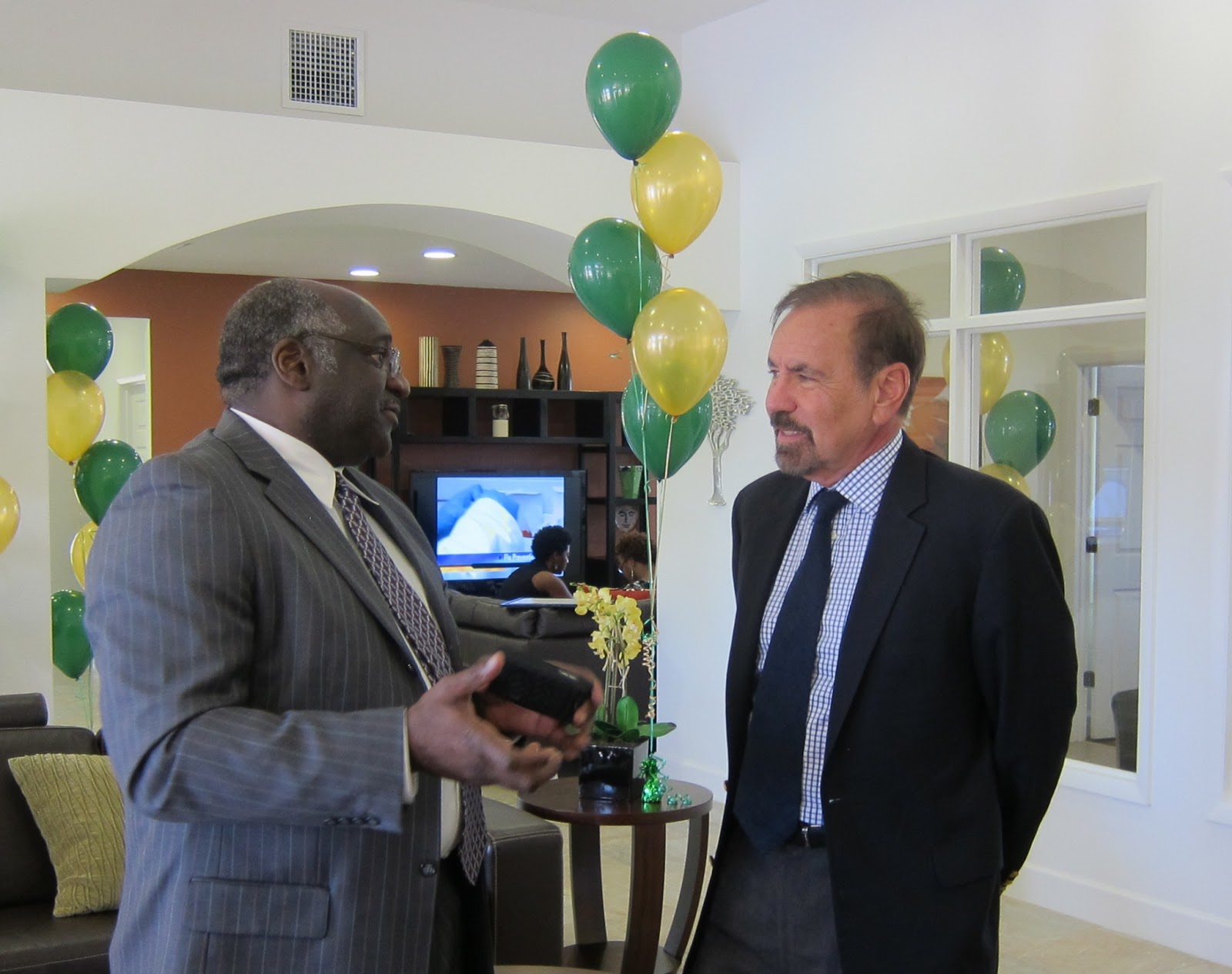
Doug Gaither and Jorge Perez

I attended the grand opening of Emerald Villas along with more than 75 supporters and several beaming residents. The festivities were held in a spanking new clubhouse packed with celebratory balloons and food and beverages donated by local merchants.  At the ceremony, Jorge told me, “affordable housing developments should always look market-rate.”

These apartments certainly fit that description, and, in addition to being beautiful, the apartments are functional. Using the classrooms on site, ONIC will provide an array of resident services including financial capability classes and after-school classes. All in all, Emerald Villas bodes well for the future of residents here and the community as a whole.


Want to know more?

Wednesday, February 6, 2013

30 Years of Affordable Homes in Cambridge

This blog is part of our anniversary celebration series, highlighting NeighborWorks affiliates which are celebrating milestone years marking either their membership in the network or their incorporation as an organization. Last month, Cambridge Neighborhood Apartment & Housing Services (CNAHS) celebrated 30 years since incorporation. 

By Brittany Hutson, NeighborWorks
America Public Relations fellow
Cambridge Neighborhood Apartment & Housing Services (CNAHS) understands how rental and homeownership costs in urban locations can severely strain the finances of low income families.  For 30 years, the organization has been dedicated to creating and preserving affordable housing in Cambridge, Massachusetts.

In the late 1980s rent control in Cambridge was overturned through a statewide referendum.  CNAHS knew there would be a large number of displaced residents unable to find living space at a similarly affordable rate. To help alleviate this problem, CNAHS chose to focus on acquiring and preserving affordable homes. In particular, they targeted those properties where rent controls were expiring and owners were being permitted to convert them to market rate.

Peter Daly, executive director of CNAHS, says that some of CNAHS’ proudest achievements are their preservation projects and the fact that this work prevents lower income people from being outpriced and displaced.  “When we first encounter a project and the residents are very much aware of the threat of losing their homes, it’s an exhilarating experience to work with them [and] to give them hope that their homes will be restored at an affordable rate,” says Daly.
Putnam Green housing. Landscaping at the property features
drought-tolerant and low-maintenance plants (no grass).

CNAHS has preserved five buildings, totaling more than 515 apartments. “About two years ago, we started participating in a new state law in which the state appoints a designee to acquire and operate buildings that are subject to being sold,” says Daly. So far, the state has approved CNAHS as designee of two projects. This state designation is a recognition of the need for the organization’s work, and of all CNAHS has accomplished.

However, CNAHS is not content with just these successes; the organization has adopted a green approach to housing, development, and operations. “We believe in green because it is good for the environment, good for the residents and neighborhood, and good for the operations of the property,” explain Daly. CHAHS was one of 16 organizations in the NeighborWorks network recognized in December 2012 for its green business practices.  “The strength of being in the NeighborWorks network is having so many different organizations around the county doing similar things [as you],” says Daly. “You really get the feeling that you’re not alone. Whenever I come up with a problem or challenge, I can call another organization and we can share ideas or they can offer a solution.”

For more about CNAHS, visit:http://www.cambridgenahs.org
For more about the NeighborWorks Green Organization program, visit: http://ow.ly/hu3gT  

Wednesday, January 30, 2013

NHS of Greater Cleveland: A Port in the Foreclosure Storm

This blog is part of our 35th Anniversary Celebration series, highlighting NeighborWorks affiliates which are celebrating milestone years marking either their membership in the network or their incorporation as an organization. This month, NHSGC is celebrating 15 years since incorporation. 

By Brittany Hutson, NeighborWorks
America Public Relations fellow

The 2008 housing crisis caused many to wonder if buying a home could still be considered the "American dream." In spite of all the uncertainty about the housing market, Neighborhood Housing Services of Greater Cleveland, Inc. (NHSGC) has remained steadfast in its mission to assist their clients in becoming homeowners. “A lot of people will say Cleveland and Slavic Village was the epicenter of foreclosure, mortgage fraud, flipping, etc.,” says Executive Director Lou Tisler. “But it was also the epicenter for solution based programs for the foreclosure crisis.”

Tisler says that the foreclosure crisis gave NHSGC an opportunity to prove their value and leadership and that the crisis required the organization to be more flexible and creative. The organization was selected for the Ohio Foreclosure Prevention Task Force, accumulated nearly $5.6 million to assist people in need with the NeighborWorks Collaborative of Ohio, and provided testimony at congressional hearings.

Dave Wilson came to NHSGC to avoid foreclosure. He had
suffered an injury and struggled to make ends meet. By working with
NHSGC, Wilson was able to get an affordable loan modification.
This month, the Cleveland, Ohio organization celebrates 15 years as part of the NeighborWorks network.  NHSGC offers a number of programs to “help people get, fix and keep their homes,” says Tisler. These programs include a homebuyer education program, a down payment assistance program, providing rehab loans to those who cannot get lending from traditional banks, a sustainability program that focuses on foreclosure prevention and intervention; mortgage counseling; and EnergYOU, which helps clients and residents conserve their budgets for utilities and food costs. The organization serves primarily low-to-moderate income people, as well as people with moderate-to-high income that seek foreclosure prevention assistance. “Our clients are usually underserved, under-banked and under-represented in the housing market,” says Tisler. The organization serves up to 3,500 people per year.

Raylene Hood reached out to NHSGC for assistance in saving her home. A
NHSGC counselor helped her apply for rescue funds to bring her mortgage current.
NHSGC also helped Hood when she needed emergency repairs on her roof.
Though NHSGC has seen its fair share of challenges in home equity, lack of access to capital, and limited lending, Tisler praises his staff of 16 for their motivation and commitment to serving the organization’s targeted community. “The staff [has been] the greatest asset to the organization,” says Tisler. “Our staff has gotten us to a solution based delivery system. To see them come in everyday and make what they do happen is incredible.”

In addition to the staff, Tisler says that being a part of the NeighborWorks network is “an incredible, valuable asset for the organization and the people we serve.” He adds, “As a network member, NHSGC has access to best practices and funding, and can share experiences and ideas with other network organizations. It is truly a network of excellence.”