Wednesday, January 29, 2014

Is there truth to those renter stereotypes?

By Pam Bailey, NeighborWorks America blogger

The national “ethos” that values homeownership over renting has a long history. On Dec. 2, 1931, for example, President Herbert Hoover said in an address to the White House Conference on Home Building and Homeownership, “[There is] the high ideal and aspiration that each family may pass their days in the home that they own…There can be no fear for a democracy or self-government or for liberty or freedom from homeowners, no matter how humble they may be.”

A white paper from the National Multi-Housing Council observes that today, its members encounter so much preference for homeowners that, “When an apartment community is proposed… local activists respond with NIMBY (not-in-my-backyard) complaints so frequently that some have suggested a better acronym might be BANANA (build absolutely nothing anywhere near anyone).”

Every renter is different, of course, just as are homeowners. So some renters – whether they live in an apartment building or single-family house -- don’t take care of their living environment or interact with their community as much as is ideal. (The consensus seems to be that a critical determinant is whether the planned stay is temporary or longer term.) As for impact of rental housing on property values, it depends on a lot of factors, such as the number of units, the characteristics of the tenants and the nature of the owners and management. But the facts don’t support broad generalizations.

Most studies in this arena have focused on clusters of rental housing -- such as apartment complexes -- and on lower-income tenants, rather than on scattered, individual rental homes. But the findings offer plenty of caution about buying into negative stereotypes related to either quality of community living or property values.

For example, the Joint Center for Housing Studies found several years ago that apartment residents – who represent the highest-density renters – are almost twice as likely to socialize with their neighbors as homeowners, and are just as likely to belong to structured social groups and to closely identify with the town or city in which they live. (The one area in which apartment residents significantly lagged homeowners in this study was voting in local elections.) It’s true that other studies have produced data suggesting that homeownership is associated with a better social environment, such as a lower crime rate, improved educational achievements among children and greater involvement in neighborhood organizations. However, these studies typically don’t control for confounding factors such as chronic unemployment. The bottom line: The picture is clearly mixed, with data available for arguments on both sides.

Most renters (42 percent) live in apartment buildings, followed by 34 percent who choose single-family homes.
As for property values, a Boston study by the MIT Center for Real Estate concluded that, “the introduction of large-scale, high-density mixed-income rental developments in single-family neighborhoods does not affect the value of surrounding homes. The fear of potential asset-value loss among suburban homeowners is misplaced.” A presenter to Harvard’s Joint Center for Housing Studies’ Revisiting Rental Housing summit agreed, writing, “The fear that housing density will hurt property values seems to be primarily based on anecdotes. By contrast, most research has come to a different conclusion: In general, neither multifamily rental housing, nor low-income housing, causes neighboring property values to decline.”

Bernadette Orr, director of community building for NeighborWorks America, observes, “Most of our groups that work at the neighborhood level deal with these stereotypes and the resulting challenges in one way or another. That’s why our groups have gone in the direction of helping to support neighborhood associations instead of homeowners associations.”

Of course, anecdotes of the negative consequences of “the renters” abound. Even some of the nonprofit housing professionals interviewed for this series had such stories to tell from their own neighborhoods. Whatever your point of view or experience, however, renters are here to stay. The demand for affordable rental housing – homes or apartments – is growing. According to a December report from Harvard’s Joint Center for Housing Studies, American households are increasingly turned to the rental market for their housing. From 31 percent in 2004, the renter share of all U.S. households climbed to 35 percent in 2012, bringing the total number to 43 million by early 2013.  And they aren’t just young adults just out of college; a third are between the ages of 35 and 54.

So what can be done to bridge the divide between renters and owners? The next two installments of this blog will explore innovative solutions from member organizations. Check back daily to read the rest of the series, or sign up (see box, right) to receive new posts directly in your inbox.

Tuesday, January 28, 2014

Survey shows chasm between renters, owners

By Pam Bailey, NeighborWorks America blogger

Owning your own home is considered by many to be an essential element of “making it.”  In fact, a recent national survey commissioned by NeighborWorks America found that 88 percent of adults say homeownership is at least somewhat important to their definition of achieving the “American dream.”

Chart showing that 55% of renters are not currently considering buying a home, while 42% are.
However, according to Harvard’s Joint Center for Housing Studies, more than a third (35 percent) of all adults in the country are currently renters. And the NeighborWorks America survey found that slightly more than half (55 percent) of renters are not intending to change that status – at least not now. I am one of them (both out of choice and necessity), and sometimes, with the strong U.S. cultural bias towards homeownership, it can feel a bit like being a second-class citizen – especially if you aren’t a 20-something fresh out of college, in which case everyone knows it’s just a matter of time.

Perhaps no other story in the media best captured this public ambivalence about renters than an Aug. 28 article in The New York Times, headlined “As Renters Move In, Some Homeowners Fret.” Writing about a neighborhood in which a growing number of single-family homes were being occupied by renters in the wake of the foreclosure crisis, the author wrote: “The decline in homeownership is changing many neighborhoods in profound ways, including reduced home values, lower voter turnout and political influence, less social stability and higher crime.”

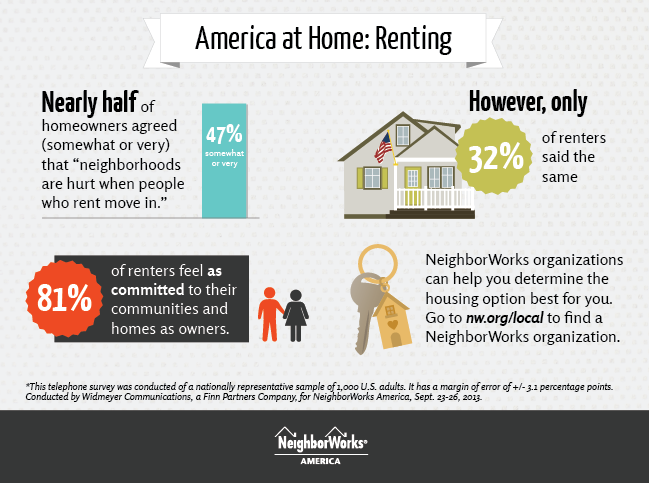
Graphic showing that while nearly half of homeowners think renters hurt neighborhoods, renters feel just as committed to their communities as owners.
The New York Times ran a second such article ("Homebuyers are Scarce, so Renters Take Their Place") on Dec. 5, quoting Atlanta-area residents who were alarmed at the news that a number of houses in their neighborhood were being rented rather than sold: “I can see three or four or five rentals in this neighborhood, but the whole community? I’m worried about my property value,” said one.

In the NeighborWorks America survey, nearly half (47 percent) of homeowners agreed (somewhat or very) that “neighborhoods are hurt when people who rent move in.” However, only 32 percent of renters said the same, and 81 percent described themselves as being as committed to their neighbors and community as they would be if they owned their residence.

So…what explains the gap in perceptions? And, how can we build more of a community between the two groups, so that we’re all neighbors -- not owners vs. renters? The next three blog posts will explore those questions. Check back daily for the rest...or sign up to receive new posts directly in your inbox!

Wednesday, January 22, 2014

Alaska group provides 'one-stop shop' for homeless

By Pam Bailey, NeighborWorks America blogger

Homelessness has many causes and spawns many needs, making it difficult to coordinate the multiple visits and services required to stabilize these individuals and put them on the road to “recovery.” That challenge is what inspired the San Francisco Department of Public Health to host its first “Project Homeless Connect” event in 2004, and today, more than 260 other organizations have been trained to follow suit – including NeighborWorks Anchorage in Alaska.

The organization, which recently celebrated its 20th year as a member of the NeighborWorks network, will participate for the seventh year in the Anchorage Project Homeless Connect on Jan. 29. During the event, more than 125 companies, other nonprofits and government agencies provide on-the-spot services such as dental care, eye exams (complete with glasses, if needed), HIV and other types of medical testing, haircuts, application for housing and medical-care programs, employment counseling, legal advice and wheelchair repair.

“Because we never know if they will stay in touch, it’s our goal to actually ‘close the loop’ as much as possible for every service we provide at the event,” says Vickie Dodge-Pamplin, community engagement specialist for NeighborWorks Anchorage, adding that every person is given a hot lunch and a bag of groceries to take with them. “For example, if they need to replace their ID, which they need for just about every benefit program, we’ll drive them to the closest DMV office and get it taken care of right then and there.”

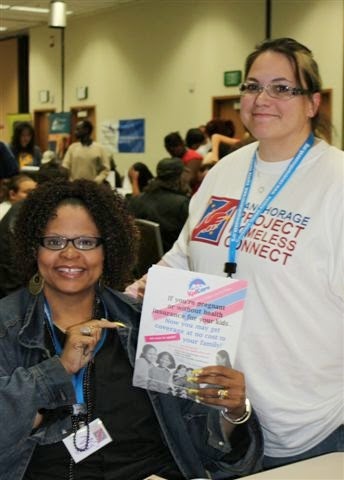
A volunteer (right) shares information on
services for pregnant and at-risk women
with an attendee.
Held in the city’s convention center, last year’s event attracted more than 700 participants, with sponsorship from companies such as ConocoPhillips and nonprofits such as United Way. To spread the word, the event team goes to camping areas, soup kitchens, bus stops and churches – wherever the homeless often congregate. It has proven so effective in drawing these individuals into the network of care that organizations in Juneau and Fairbanks also are participating.

This initiative and others that target homelessness are coordinated by the Anchorage Coalition to End Homelessness, formed following a mayoral task force focused on the growing crisis in 2004.  The coalition has made significant progress since then, but much work remains in order to reach its goal of ending homelessness: From 2011 to 2012, Alaska’s overall homeless rate declined 10 percent, according to a report last year from the National Alliance to End Homelessness. But the number of chronically homeless people rose almost 21 percent, giving Alaska the ninth-highest increase in the country. The largest percentage of participants in the 2013 Anchorage Project Homeless Connect (25 percent) reported becoming homeless primarily due to job loss. The second-most-cited causes were mental health problems and substance abuse (14 percent). More than half (56 percent) reported being homeless one to three times in the previous three years, with 19 percent saying they had been without shelter more four or more times. The New York Times wrote about the persistent problem in a Dec. 7 article titled, Alaska’s Thin Line Between Camping and Homelessness.

“A lot of people come to Alaska from out of state, because they’ve heard about the oil-subsidy program,” says Dodge-Pamplin, explaining that oil companies operating in the state are required to contribute money to a fund that in turn pays Alaskan residents an annual stipend that can range from $800-$1,200 or more (depending on how many people qualify in a particular year) – a nice benefit, but not much of a cushion for a large family. “What they don’t realize is that it takes a year to become an official resident, and in the meantime, both rents and jobs are not that plentiful.”

"Ben" and a co-worker go out into campsites
frequented by the homeless, to connect them to
services and care.
The coalition supporters and members, including NeighborWorks Anchorage, also participated last year in a program of the 100,000 Homes campaign, designed to better find and document the needs of the most vulnerable homeless in cities across the country. A team fanned out across greater Anchorage, offering $5 McDonald’s gift cards to homeless individuals willing to be interviewed and have their picture taken. Each was entered into a database, categorized by their level of vulnerability.

“Being in a permanent home, not just temporary shelter, is so central to everything,” says Dodge-Pamplin. “I particularly remember one woman named Mary who came to town to have surgery for breast cancer. She had to stay in the area to have chemotherapy, but couldn’t afford any place to stay. A case worker brought her to us, and we found her shelter until we could arrange something longer-term. Today, she is living in one of our apartments for seniors and makes quilts for babies in the hospital. Her treatment is going well. Now, that’s why I get up in the morning.”

Want to organize a similar “connect” event? In addition to visiting San Francisco for observation and training, Dodge-Pamplin offers a few tips:

  • Make sure that all participating agencies understand that it’s not enough to distribute brochures. They should be ready and equipped to go as far as possible to provide the actual service on the spot, or at least that day.
  • Practical services such as foot care (toenail clipping is very much in demand!) are just as important as medical care and counseling.
  • Treat each person with respect, one-on-one, no matter what their background or track record.


Tuesday, January 21, 2014

MLK Day is over, but volunteering brings rewards all year

By Natalie Kessler, NeighborWorks VISTA Leader

Martin Luther King Jr. famously once said, “Life’s most persistent and urgent question is ‘What are you doing for others?’ ’’ That sentiment, which so aptly reflects the focus of his life, is at the heart of Martin Luther King Jr. Day  -- the only federal holiday designed to encourage Americans to commit to a day of service. But volunteerism is a contribution – and a joy – that can and should be practiced throughout the year.  

Take me, for example. As a participant in the AmeriCorps VISTA program, when individuals ask what I do for a living, I could respond in a number of ways. I could say I help a diverse group of people accomplish tasks around the country. I could respond with a long-winded description of how I provide administrative support, resources and other assistance to individuals who are striving to make their communities a better place. My actual answer? “I volunteer.”

The inspiration for AmeriCorps VISTA dates back 50 years, when President John F. Kennedy first spoke about his vision for a national service program in 1963. Two years later, Lyndon B. Johnson made that dream a reality as part of the “War on Poverty.”  The VISTA program initially had only 20 members. Johnson said to them, “Your pay will be low; the conditions of your labor often will be difficult. But you will have the satisfaction of leading a great national effort and you will have the ultimate reward, which comes to those who serve their fellow man.”

VISTA member Emily Pohlman (second from left) from 
Neighborhood Housing Services in Boise, ID, volunteered 
with employees from a local credit union to sort and 
distribute warm clothes for children.
President Johnson was right. The pay is low (just a stipend for living expenses) and my tasks are challenging… but the results are incredibly rewarding and I’m getting great experience. I lead, assist and provide resources for approximately 95 NeighborWorks VISTA volunteers across the United States. These VISTA volunteers serve local communities by creating course curricula for financial education and home-buying classes, coordinate other volunteers to complete home repairs in low-income communities, write grants for neighborhood-beautification projects, run fundraising and youth literacy programs, etc.

However, you don’t have to be a volunteer full-time. There are many opportunities to contribute in “small batches.”

Why consider giving up even a little of your free time?

Direct service is satisfying.
Volunteering feels good! I volunteered on MLK Day because I wanted to be more involved in my new home city, Washington, DC. Yes, my VISTA position is classified as volunteer, but it is also my job. As such, it doesn’t generate quite the type of satisfaction that flows from direct service. Plus, it’s fun to I get out into in my community and interacting with others.

VISTA members (three on the left) work with 
NeighborWorks Blackstone River Valley in 
Woonsocket, RI, to  paint a shed. 
You help causes you care about.
If you’re like me, you follow favorite local nonprofits on social media. Volunteering  offers the perfect opportunity to experience their work firsthand.

Nonprofit organizations rely on you!
Many nonprofit organizations rely heavily on the work of volunteers. They couldn’t fulfill their mission without the contribution of your time.

It’s a great way to meet like-minded people.
Volunteering is a natural way to make new friends, and I’ve even heard of some people finding their “soul mate” that way. You can also learn new skills and broaden your knowledge.

A  report from the Corporation for National and Community Service found that one in four adults volunteered through an organization in 2012. Altogether, 64.5 million Americans volunteered nearly 7.9 billion hours. Why not join them? You can volunteer as much or as little as you like – whether it be a couple of hours a year, a month or every week. If you don’t have a favorite local nonprofit already, you can search for a service opportunity through any one of these three websites:


What are your favorite ways to volunteer? Do you have tips for fitting it into your schedule?


Tuesday, January 7, 2014

Lease-to-purchase program provides pathway to homeownership

By Pam Bailey, blogger for NeighborWorks America

Kalamazoo, MI, was hard hit by the housing crisis. Traditionally a first-mortgage lender, with 600 loans in its portfolio, Kalamazoo Neighborhood Housing Services could no longer offer that assistance as banks pulled back. Meanwhile, as unemployment also soared, foreclosures swept the city and even now, four years later, home values are stagnating and lack of investment is destabilizing the neighborhoods.

“We needed a strategy to provide a bridge to homeownership, while also stabilizing the community by avoiding the abandoned buildings and absentee landlords experienced elsewhere,” says Matt Lager, executive director of NHS, which recently celebrated 20 years of membership in the NeighborWorks network. “So we developed a lease-to-purchase program.  The formula is simple: We acquire and rehab a vacant or foreclosed property on a target block, lease to clients who are just shy of mortgage-ready and prepare them to become homeowners. The result: We now have a pipeline of families who will transition to homeowners within 12 to 18 months.”

One of the families now leasing a home, with plans
to purchase. 
In the first two years of the program, Lager’s organization acquired 11 houses outright, thanks to a combination of land donations, grants and capital from NeighborWorks America. Five more acquisitions are planned for the coming year. Demand has been high, with 20 “bidders” for every home available. In return for the affordable lease and down payment assistance when the time comes, renters agree to participate in monthly financial-management coaching sessions. If they don’t follow through, or decide not to purchase within two years, they lose their “option fee,” equivalent of one month’s rent. (If participants comply with the action plan they develop with their coach, the purchase deadline can be extended.)

To date, the program has a high success rate: Four of the participants will become homeowners in the first half of 2014; only two have opted out due to what Lager calls the programs initial “learning curve.”

Lessons learned

“One of the lessons we learned in implementing this program is to select and then rehab houses that would attract future homeowners,” explains Lager. “People need to fall in love with a house to stay motivated.”

The other lesson Lager’s team would pass on to others who might want to offer a similar program is that it requires deep relationships with leasers.

“Although the financial-management sessions are focused on budgets, repairing their credit, etc., you can’t help but get involved in all of the other issues that dictate whether these families can be successful at homeownership,” says Lager, adding that the NHS financial-capability coaches have backgrounds in social work. “That means dealing with unemployment, for instance, and similar challenges.”

Foreclosures may have gone down, but the financial struggles of the approximately 21,000 people living in the six neighborhoods served by NHS continue, and the “lease-purchase” program will help provide a pathway to homeownership.