Tuesday, August 28, 2012

How to Create a Community Garden

We couldn't resist including this wonderful last piece in our community gardening series. Thanks to all who sent in entries and to all those who work on gardens across the country.

By Bob Halstead
Founder, Bridgeport Urban Gardens

Photo courtesy of The Housing Development Fund, Inc. (HDF)
I've had 30 years of experience building community gardens and I can tell you they always start from the heart.  The first step is to assess if the commitment is there from the neighborhood.  The rule of thumb is that there need to be five people solidly invested at the start.  The number of participants will grow later.

If there is not a community garden organization in your area, you can probably find one to partner with.  Here in Connecticut we have the Connecticut Community Gardening Association.  Working with an established organization can give you technical assistance on how to go about the nuts and bolts of creating a community garden and may also provide access to resources and connections supportive of community gardening.

As in any development project, there are several critical ingredients needed to create a community garden.  Interest and commitment are an important first piece, and the next crucial piece is a site, which must have good sun and water.

Photo courtesy of HDF
To secure a site, you either need an agreement with the owner, or you have to buy it yourself.  The ideal site is one that is in close proximity to where the interested community lives.  Having a site that is walkable for those who are involved makes it easier to maintain and check-in when walking by.  Increasing pedestrian traffic also improves the community.

After locating a desirable parcel, the owner must be contacted and a contract must be formed.  Municipalities, religious institutions, schools, housing complexes (public or private), and community centers are common partners for land agreements to establish community gardens.  Private landowners are also common site owners for gardens, and contracts can be tailored to suit all of these groups.  Tracking down the owner of a specific piece of property will be easiest for someone with knowledge of real estate, and may involve going to town or city hall to research land records.  If the owner is already known, you simply need to approach them with a proposal for what you have in mind.

Working with a private owner often has benefits compared to dealing with municipalities or institutions, which can be a time-consuming and complicated process.  A private landowner may welcome a community garden, especially during difficult economic times as it may free them from maintenance issues until such time as the market will support a development.  Private landowners often can avoid some cumbersome taxes by deeding a property to a nonprofit as a tax deduction, and this may be one reason to investigate either partnering with a nonprofit or registering your garden as a 501(c)3.   Insurance is also a big issue, and can be another reason to consider working with an established nonprofit corporation who might offer to include you under their policy and be the fiduciary for your gardening group and the contract holder.

Photo courtesy of HDF
Working with municipalities who own vacant lots or park land often requires working closely with your governmental representative or the city planner for your town.  Use of municipal land will eventually require the approval of the governmental body and chief elected official. To gain approvals, it is best to mobilize the community and bring out supporters to public hearings either in person or with letters to representatives and the local media.  Positive press can encourage elected officials to participate and be seen in a good light politically.  It is worth noting that some municipalities may offer dedicated staff people to coordinate your program and provide public works machinery.

There are basic templates are available on land agreements and can be found through a local community gardening association or on the Internet.  It is desirable to have a commitment for five years with three years the minimum, given the amount of work and investment that has to be made on a garden.

The next step is to create a budget, which should include such items as water systems, fencing, lumber for raised beds, tools, sheds, plants and topsoil.  Start-up costs for a community garden can range anywhere from $3,000 to $10,000. If your local community gardening agency has staff or volunteers to assist you with budgeting and/or locating resources, you should absolutely engage them.  If you are eager to get started quickly and cannot yet secure, for example, water service to the site, seek agreements to use what is available.  Neighbors might allow use of their water line, or there may be existing soil available (some communities have a town compost program). 

Always work with an eye toward bigger improvements down the road.  Having the garden up and running (along with property control) can play a huge part in helping you secure grants, participation and donations to continue developing your site.  Hosting a fundraiser on site once you’ve begun to get the garden in place can be a dynamic way to excite donors and the community.

Early on you need someone to ask as a captain who assigns plots after doing canvassing in an area.  Once all the basics are taken care of, a garden is a sustainable operation.  People then appreciate what they have and will work to keep it.  They usually know how to garden or are willing to teach those who don’t and they really appreciate it socially. 

Partnerships are invaluable to the success of a community garden project, especially in depressed urban areas.  If the core supporters of the garden are willing to ask, you can uncover a tremendous outpouring of altruistic activity from corporate institutions, organizations such as United Way, churches and schools.  Volunteer groups can show up for all or part of a day and quickly supply you with the needed ‘whack’ to construct your raised beds in a matter of a few days. 

HDF partnered with Bridgeport Urban Gardens to bring a volunteer day to the
Clinton Avenue Community Garden in Bridgeport, CT.
Photo courtesy of HDF
Success breeds success...and funding.  Once your garden has started to take shape, getting some exposure as a community garden will make it is easier to get funding.  Available funding sources include: HUD Community Development Block Grants (through a municipality), state Departments of Environmental Protection, community foundations, philanthropists, state or local Health Departments, educational programs, corporations and national foundations, and local businesses (who might donate in-kind with supplies or services).  The Keep America Beautiful Foundation, for example, offers grants in partnership with Lowes that can be used for community garden projects. This year, for NeighborWorks Week, the Housing Development Fund, Inc.co-hosted a volunteer day with Bridgeport Urban Gardens which received one such grant. It was used to provide the garden with a host of supplies and materials that we used on site – mulch, plants, a new shed, organic soil mix, etc. The one-day effort resulted in a wide-reaching refurbishment of this beloved community space, including mulching of pathways, construction of a supply shed, tilling and planting of garden beds and the involvement of members of a special-needs class from the high school that sits across the street from the garden site.

Happy gardening!

Thursday, August 23, 2012

From Vacant Lots to Community Gardens

By Case Wyse
Pathstone Community Improvement of Newburgh
   
From the rubble of vacant, neglected, and under-utilized land, Newburgh Community Gardens in New York are gently picking up steam as raised beds become the signature of cheap, delicious local food. The gardens are made possible by a collaborative effort among Pathstone Community Improvement of Newburgh, the Newburgh City Council, and the hard work of numerous AmeriCorps volunteers and local residents.
Dutch Reformed Church garden

The official process started when Pathstone Community Improvement of Newburgh applied for a grant through the city council.  As part of the application process, soil tests were conducted at each of the potential garden sites. This data was appended to the maps created earlier with the help of the Orange County Office of Planning and Development.  After site selection, public events were held seeking community input and interest.  From this information, a plan detailing the intended owners and stewards of each garden was drawn up and presented to the city. All this work paid off when the Newburg Community Gardens got the green light.     

Recently, Newburgh welcomed the addition of two more public gardens cultivated from the efforts of several dedicated organizations.  The garden at the Dutch Reformed Church is adjacent to the city library and sits before a monolithic set of pillars characteristic of Newburgh’s aging architectural wonders. Immediately following and during the installation of this garden, the community began to take notice and offer assistance. 

Boys at San Miguel work on garden
Though the program is still in its infancy, community enthusiasm continues to encourage other organizations to take responsibility for managing a garden bed.  In the case of San Miguel Academy, a single bed was insufficient. On the corner of Farrington and Lander, a former high-crime risk center in the city, there is now a beautiful series of raised garden beds constructed and maintained by recent graduates from the academy.  These beds offer the unconventional classroom for educating future generations to properly maintain fruits and vegetables. The rising trend towards local food means that developing an urban agriculture skill set could ensure a wholesome meal and job security in the future.

Armory Garden's green team
Along with San Miguel Academy, a number of other community organizations have undertaken the responsibilities gardening. At the Newburgh Armory Unity Center more than 30 garden beds stand ready for the 2013 growing season.  In the two years since its inception, the Armory Garden has hosted everyone from the first-time gardener to the life-long green thumb.  This diverse range of gardeners and organizations provides the social system which underlies the future success of Newburgh’s community gardens.  Plans currently under development include a food dispersal network in which produce from each of the gardens could either be donated to local food pantries or sold at the local farmers market, a city-wide composting program, and a nursery capable of supplying all the vegetable starts necessary for gardeners across Newburgh. 

Wednesday, August 22, 2012

Las Monjas Community Garden

Our community garden series travels to San Juan, Puerto Rico today. This post was originally published on the Enterprise Community Partners blog, @The Horizon.There were some minor edits to this reposting. Learn about the Enterprise Rose Architectural Fellows Program here


By Juan Calaf, Enterprise
Rose Architectural Fellow
Earlier this year ENLACE, a community-based organization in San Juan, Puerto Rico created an organic community garden with the residents of Las Monjas neighborhood. Las Monjas is one of the most densely populated and poorest neighborhoods in Puerto Rico. Las Monjas Community Garden is the only organic community garden in the entire Caño Martin Peña neighborhood comprised of around 27,000 residents. Initially, the residents volunteered their time to clean what was once a vacant neglected lot where illegal dumping occurred. After several months of clean-up and building raised beds the community has now a vibrant and diverse garden producing mostly organic vegetables, lettuces and spices (ie. pumpkin, arugula, basil) for the residents to eat and in some cases to sell at community events.

Last month a community garden organizer from ENLACE, Roberto, asked me if I would help them to plan for the future expansion of the garden, given that they now have a new parcel to the eastern side and to the north of the garden. ENLACE got some funding from the Ford Foundation to build out some structures necessary for the garden to be more self-sustaining. Since then, I have participated in various meetings with the community leaders and garden organizers to come up with a list of priorities and to create a more holistic design for the garden. The group wants to include an outdoor classroom, a larger composting area, more garden beds and a nursery garden area. There are also some improvements planned for the existing fencing around the garden as well as a new gate to provide better access into the garden.

Juan garden1
Las Monjas Community Garden
I have been helping with the schematic designs for the second phase of the garden’s design. This phase will also include a rain-water collection cistern connected to a roof, shading devices to minimize wilting from the extreme summer heat and a mechanical composting facility all to make the garden more self-sustaining.
Community gardens like Las Monjas and others around the country serve two vital functions for the community. First, they support food independence by teaching organic gardening practices to youth and families to have their own low-cost alternative to eating local produce. Second, they foster better relationships between neighbors by encouraging strong collaboration and participation which ultimately has a positive overall impact in the neighborhood.
Juangarden2
Community Garden Design Meeting Sketches
Juangarden3
Want to start a community garden in your neighborhood? Click here

Tuesday, August 21, 2012

Transforming Neighborhoods with Vision and Partnership

This blog entry shows how gardens are one piece of community transformation, along with other green efforts and a little artistic creativity. This story was originally published on the Leaders for Communities blog here

Bernadette Orr, director, 
Community Building & Organizing
Last week I had the good fortune to spend two days visiting with Community Building and Organizing member groups in our Northeast Region.  As with so many “hands-on” experiences, what I expected when I left on the trip was far exceeded by the many insights and lessons learned over the two days.

I started the visit in Philly, where New Kensington CDC (NKCDC) was hosting guests from Argenta CDC North Little Rock, Arkansas.  Mary Beth Bowman, Agenta CDC's executive director, and Shanta Nunn-Baro, their resource development and IDA manager, came up from Little Rock to learn more about what NKCDC has done to “green” their neighborhood.  In particular, they wanted to learn about urban farming – something they hope to replicate back home.

Teens 4 Good mint plant. Teens 14-18 years old
produce about 3000 lbs of food on this lot every year.
We visited a fantastic and productive local farm called Teens 4 Good run by neighborhood youth, a beautiful plant nursery and produce center operated by GreensGrow (“growers of food, flowers, and neighborhoods”), and stayed a while at NKCDC’s own garden center.  Along the route, we passed numerous small lots transformed from abandoned, weedy, problem sites to thriving community gardens. While at the garden center we saw local families coming by to pick up their weekly food shares of fresh produce, as a local chef provided cooking demonstrations and handed out that week’s fresh food recipe.

The weekly farmers market attracts
500-1000 customers each week.
As the day progressed, we slowly realized that, even more than the “green” theme we had come to explore, what we were really learning about was the power of partnerships. Each group brings their own particular expertise to the table and shares a vision of healthy, vibrant communities, and a commitment to neighborhood transformation in partnership with local, resident leadership.  The collective effort brings forth a resulting transformation that is nothing short of magical.  Housing, streets, businesses, art, food, youth, health, education, festivals, community building – everywhere we turned we saw the threads interwoven with impressive results.

This produce for NKCDCs farm to families program is
worth at least twice the $10 charged.
We ended the day back in the office, learning more about how NKCDC’s participation in a project called Sustainable 19125 is moving the neighborhood from the challenges of more than 1000 abandoned lots strewn with trash and debris to Philadelphia’s greenest zip code (click to watch a great video about this work). You can access more photos from the trip on my Twitter account:  @boylstonst.


Monday, August 20, 2012

Coachella Garden Brings Community Together

It's harvest time and community gardens are providing a bounty for people of diverse ages, backgrounds and geographies, so this week we're focusing our blog on a few great stories from these local growing efforts. This story was originally published as an article on the Coachella Unincorporated website. Coachella Unincorporated is a youth media startup in the East Coachella Valley, funded by the Building Healthy Communities Initiative of The California Endowment and operated by New America Media in San Francisco. 

By Johnny Flores
Youth reporter
Coachella Unincorporated

When Hilda Hinojosa’s baby has colic, all she has to do is walk across the parking lot and pick some manzanilla from among the various vegetables, fruits and herbs at Las Casas Apartments Community Garden.

She uses the herb, also known as chamomile, to soothe four-month-old Berenice to sleep.
“I don’t drive, so it’s much easier to come to the garden,” said Hinojosa in Spanish. “It would take me longer to get to the store, and my little girl would still be crying.”

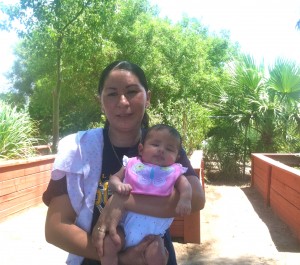
The residents of Las Casas Apartments work together in their community
garden, sharing their bounty with one another and their neighbors. Hilda
Hinojosa (above) grows and shares the manzanilla that she uses to make
tea for her daughter, Berenice. Photo credit: Coachella Unincorporated
Hinojosa has been planting in the community garden ever since moving to Las Casas eight years ago. During that time, she has developed a bond with her fellow community gardeners. The 20 or so active participants tend to their individual crops and share their bounty with one another. Because many are migrant farmworkers, the community gardeners look after each other’s crops when some leave the area to follow the seasonal harvesting work. One active gardener, Jesus Sandoval, even devised an irrigation system that makes the gardening easier for everyone.

Residents who don’t participate in the community gardens are still welcome to pick from them.
“I share my cilantro with everyone,” said Hinojosa, who plants hierba buena (spearmint), onions, nopales, (cactus) and cilantro. She makes salsa from the peppers and tomatoes grown by her neighbors.

Beatriz Gonzalez, who has also been an active community gardener at Las Casas for eight years, shares her corn, radishes, and strawberries. “We share what we plant with whoever needs it,” said Gonzalez, who works in the community garden after a full day of picking grapes in the fields of the Eastern Coachella Valley. “We let them in and give them what they need.”

Residents at Las Casas discuss their garden
Las Casas is comprised of three smaller complexes totaling 180 units of farmworker and family housing. This multi-family project was developed and is owned by NeighborWorks affiliate Coachella Valley Housing Coalition (CVHC), an award-winning non-profit organization dedicated to building low-income housing throughout the region. The organization provides a variety of comprehensive community service programs, such as childcare programs and computer classes, at each of its 31 multi-family complexes. Las Casas is one of five CVHC complexes with a community garden.

“These are farm workers who work to feed the country but don’t have access to food themselves,” said Josseth Mota, community services coordinator for CVHC. “We want to strengthen the community and allow the residents to work for pleasure and benefit outside of their normal job.”

Nadia Villagran, CVHC’s director of communications and operations, affirms that the gardeners are harvesting community along with their crops.
A close-up photo of the Las Casas bounty

“Through these gardens, we hope residents of Las Casas feel a true sense of community,” said Villagran. “In doing this, we want to be able to sustain the community and help those who cannot afford fresh produce to feed their families.”

To learn more about housing opportunities, or find out how you can help, visit www.cvhc.org or call (800) 689-4663.